Serbia's arrest of Mladic "might be a very strong turning point" for the Serbia-EU thing, someone wrote in a comment on GV yesterday.
It usually horrifies me to imagine a similar scenario for Ukraine, but I do get carried away sometimes.
First, half a decade of war. Then, business as usual, sort of, and also catching some of the war criminals, at a rather leisurely pace, leaving the most odious ones for dessert - at which point everyone around is so tired of waiting that they let you in without even lifting their heads to look at you. Something like that. War as the EU's entrance fee, more or less.
(There's the Russia factor, of course: Russia may be happy or unhappy about Serbia joining the EU - or both - but who cares.)
I'm so happy Ukraine has managed to stay sane and peaceful over the past two decades, but I do wonder sometimes what we have to do to get to our own "strong turning point" - or at least to have them allow us to travel to Europe visa-free, the way they allowed Serbian citizens a year and a half ago...
Sunday, June 12, 2011

Another bunch of pictures from a whole day of walking yesterday. I wish I weren't so exhausted, I wish I could write a little about some of these photos, and about other stuff that I've seen and heard lately, I wish I could write anything at all now, I miss writing, but I'm so incredibly tired, and also a little bit sick, so here are just the day's pictures...
Thursday, June 09, 2011


Tuesday, June 07, 2011


Half a month ago, I posted these two pictures of the sparrows that Marta and I were feeding at the park in Moscow, and I showed them to mama today, she loved them, and then she went out and came back with two baby sparrows that she found in the grass on Khreshchatyk. Had we lived in some park, she would've left them there, for their parents to continue caring for them. But on Khreshchatyk there are too many people and too many cars, this place is a bit too tough even for humans, no way these poor birdies would've survived it.
Our cat is growing more and more interested in them, and they require more or less constant feeding, but I do hope they'll survive. Mama is a former biologist, and she has tons of positive experience with all sorts of ordinary birds and animals: we've had pigeons and crows at home, and frogs and rats, and cats and dogs. Life is never boring in our family.
I looked up baby sparrow feeding tips on the web: turns out that in the States one needs some special permit to keep a sparrow at home - because sparrows are considered wild animals or something there. Which they are, of course, but still, I wonder if it's true about the permit.
On a different note, I saw a Svoboda Party rally against political repressions today - it was a comparatively small one, they were moving down to Khreshchatyk from the Shevchenko Park, and there were plenty of cops around them - as well as around the Lenin monument and the communist tent next to it. Haven't seen anything in the news about this rally yet.
And when I was walking past the 5-star Premier Palace Hotel on Shevchenko Boulevard in the evening, an elderly priest (or was he a monk?) asked me for some change: he was dressed in a neat black robe, had a neat beard - but the golden/gilded/shiny cross on his chest was too huge, too conspicuous, too in-your-face. I asked him where he was from, and he said, Konotop, in Ukrainian. His left eye was missing. I had a fleeting thought that he might be just posing as a priest (or a monk), but I gave him some money anyway - because even if he was a fake, he still didn't look like one of those Premier Palace guests to me.
Back home, we watched "Rio" with mama and Marta, to mark the arrival of the baby sparrows.
And an hour or so ago, I saw a very tall bum down at the playground: he was collecting empty bottles into a white plastic bag. He drank up whatever remained in a couple of those bottles, and seeing him do it made me really sad, even though this is definitely not the first time I observe something like this at this playground.
And it all got me thinking of food chains.
Baby sparrows feeding on the soaked cat food that our cat can't eat because of his health problems; the cat who'd really like to eat the sparrows, and that unhealthy cat food as well, but is on a diet; an eccentric-looking priest/monk who is quite conveniently begging for money next to a 5-star hotel; communists camping by the Lenin monument across the street from the 5-star hotel, and their Svoboda adversaries, all part of the really lucrative political food chain; local cops who seem to be regularly making some pocket money off the young people who drink beer illegally outside; a bum who makes some cash by collecting empty cans and bottles, and also gets to fill up on the beer and gin & tonic left over by those young people who got busted by the cops; and, finally, another bum, who is at the playground right now, surveying the locations already covered by his colleague - he leaves with nothing except for a large cup of cola from some fast food place that he came with, most likely a find from another dump.
Monday, June 06, 2011
I took a really long, relaxed walk today. Much longer than yesterday. Once again, I didn't have any specific route in mind, just kept walking, looking around and taking pictures. Kyiv is so different from its winter self now. It is so gentle and so friendly. This friendliness has nothing to do with other people, friendly or not. It's the friendliness of a city that allows me to walk for hours on my own, never feeling lonely, bored or uncomfortable. Not even tired.
Saturday, June 04, 2011
Can't stand to see this blog so neglected - but somehow Facebook and Twitter keep getting most of my attention...
So here's a quick photoset from my first walk in Kyiv this summer (we've just arrived today) - I posted these pictures on Facebook as well, of course, and on Flickr, and I'll tweet the link, too - I swear I can't stand being fractured like this, and also repeating myself constantly, but I can't help it, either...
So here's a quick photoset from my first walk in Kyiv this summer (we've just arrived today) - I posted these pictures on Facebook as well, of course, and on Flickr, and I'll tweet the link, too - I swear I can't stand being fractured like this, and also repeating myself constantly, but I can't help it, either...
Friday, May 27, 2011
Ernest Hemingway to Martha Gellhorn, after she had gotten hysterical from observing child labor and a bunch of other horrifying things in Hongkong in early 1941 (from Mr Ma's Tigers/Travels With Myself and Another):
"The trouble with you, M., is that you think everybody is exactly like you. What you can't stand, they can't stand. What's hell for you has to be hell for them. How do you know what they feel about their lives? If it was as bad as you think, they'd kill themselves instead of having more kids and setting off fireworks."
Tuesday, May 24, 2011
A Filipino cleaning lady, who has two kids back home and is pregnant with her third one right now, works at least half a dozen jobs here in Moscow to support her family so far away. Her husband joined her half a year ago and works alongside her: a four-hour job now takes two hours to complete. She misses her kids terribly, talks to them on Skype. She has seen her 4-year-old younger daughter only once in the past three years, for a month. In the fall, she'll travel to the Philippines to give birth, but her husband will stay behind and continue working. When the new baby turns six months old, she'll return to Moscow.
From my Dear Diary, Nov. 28, 2008:
6 AM, rainy and cold, disgusting outside. From the balcony, I'm observing a guy who, with the help of a flashlight, is searching through the garbage containers and is also going through all the crap strewn around on the ground down below. As he's leaving, he tiptoes very carefully to the side, to avoid stepping into a puddle right in front of him - as if he's got something to lose if he gets his feet wet...
Sunday, May 22, 2011
So interesting to read about the Meiji period (1868-1912) in Japan in Ian Buruma's book - and when I reached the passage quoted below, I was, quite unexpectedly, reminded of the Turkish history:
I was even more surprised to run into a mention of Pierre Loti in the subsequent paragraph: the French novelist's Istanbul "headquarters" on top of the hill in Eyüp offers a great view of the Golden Horn/Haliç and is a lovely place to visit. Turns out Pierre Loti had recorded some of his observations - "supercilious and probably quite accurate" - of the Japanese "Europeanization" attempts in 1885, well before Turkey took a similar path:
And then this - which brings to mind the more recent Turkish history:
And, finally, this:
Writing almost a century later, the novelist Mishima Yukio could still work himself into a rage about the superficial primness of the Meiji years. Prohibitions on public nudity, mixed bathing, and other embarrassing signs of "the coarse and the mean" stemmed less from native prudery than from fear of foreign disapproval.
I was even more surprised to run into a mention of Pierre Loti in the subsequent paragraph: the French novelist's Istanbul "headquarters" on top of the hill in Eyüp offers a great view of the Golden Horn/Haliç and is a lovely place to visit. Turns out Pierre Loti had recorded some of his observations - "supercilious and probably quite accurate" - of the Japanese "Europeanization" attempts in 1885, well before Turkey took a similar path:
The exterior of the [Deer Cry Pavilion], designed by a British architect in a mixture of high Victorian, French Empire and Italian Renaissance styles, was likened by Loti to a provincial French spa. He thought the Japanese gentlemen, dressed up in suits of tails, looked like performing monkeys, and the ladies, lining the walls like tapestries in their hoops and flounces and satin trains, were, well, "remarkable." Doing their best to strike the proper European attitudes, gentlemen puffed Havana cigars and played whist, while others picked at the truffles and pâté and ice-cream sorbets laid out on the buffet tables. A French orchestra struck up operetta tunes, while a German band played polkas, mazurkas, and waltzes. Loti: "They danced quite properly, my Japanese in Parisian gowns. But one sense that it is something drilled into them that they perform like automatons, without any personal initiative. If by change they lose the beat, they have to be stopped and started all over again."
And then this - which brings to mind the more recent Turkish history:
It is easy to laugh at all this with Pierre Loti. But the intention behind the entertainment was serious. Inoue Kaoru was foreign minister in his friend Ito Hirobumi's cabinet. They hoped that rapid Westernization would make foreign powers treat Japan as an equal and thus agree to relinquish their privileges under the unequal treaties. [...] To critics of this kind of thing, Ito's government became known as "the dancing cabinet."
And, finally, this:
When it became clear that Western diplomats and writers were quite willing to dance, but not to revise the treaties as a result of Inoue's hospitality, the foreign minister's star began to fade. His policy was discredited, and in 1889 the Deer Cry Pavilion was sold to a private club. A backlash against all the Westernizing had already begun by then. The building, alas, is no more.
Thursday, May 19, 2011
On the way back home tonight, Marta and I ended up taking a cab, after having spent at least 20 minutes at a shitty bus stop, waiting for a trolleybus that never came.
The car was some sort of a Lada, I guess. The driver appeared to be either a Caucasus or a Central Asia native, rather young. I offered him 200 rubles, he asked softly to please make it 300, and Marta and I were too tired for me to engage in bargaining. The car's windows were tinted to such an extent that I almost fell asleep as soon as I got in, but Marta kept talking, so that saved me from embarrassing myself (what if I snored, right?).
At one point, she praised the car loudly, calling it "stylish," and I noticed that the driver began to smile. She also did quite a lot of reading of the largest logos along the way: Hitachi was one, and I explained that it was a Japanese company, and we discussed hiragana and kanji a little, and then she saw Rosgosstrakh written in really huge letters, unpronounceable and incomprehensible nevertheless, and she couldn't read it herself, of course, and I did my best to explain the basics of insurance business to her, using Iowa and tornadoes as the example, for some reason, and Marta asked if it was possible for a tree to insure itself against a storm. Since everything Marta and I talked about was funny in a cute way, I don't remember at which point the driver turned around, laughing, and asked how old Marta was.
When we got to our neighborhood, it turned out I only had a 500-ruble bill, and the driver, of course, didn't have any change, so he stopped by the kiosk and went to buy himself something and thus obtain 200 rubles for me. We sat in the car, waiting for him, listening to the 10PM newscast, with Marta commenting sadly on the sad news of a collapsed building somewhere in Vladimir. Then the driver came back, handed me the change - and presented Marta with a small pack of apple juice with a straw! We were totally delighted. I asked him where he was from - Tajikistan - and I said "rakhmat," thanking him, and Marta repeated after me, because she is by now used to thanking cab drivers in their native languages.
I do love Moscow sometimes.
Monday, May 16, 2011
Ten years since my last day in the States and NYC today/yesterday - May 15, 2001... I always remember pointless dates like this one (and in between these dates, I usually need a calendar to know what day it is)...
Anyway, it got me feeling nostalgic, so I took out my Dear Diary 2001 - and, among other things, found this clipping from the Financial Times (that I most likely picked on the connecting Paris-Moscow flight on May 16), about the late Victor Stepanovich Chernomyrdin and another dimension of "the language issue" (a somewhat distorted/exaggerated take on it):
Anyway, it got me feeling nostalgic, so I took out my Dear Diary 2001 - and, among other things, found this clipping from the Financial Times (that I most likely picked on the connecting Paris-Moscow flight on May 16), about the late Victor Stepanovich Chernomyrdin and another dimension of "the language issue" (a somewhat distorted/exaggerated take on it):
Excuse me?
FT, May 16, 2001
Victor Chernomyrdin's appointment as Russia's new ambassador to Ukraine may have taken many people by surprise, but he will have at least one advantage in his new job.
Onserver learns that he and Leonid Kuchma, the president of Ukraine, speak a slang-ridden version of Russian that is almost incomprehensible even for close associates to understand.
Given all the secretly recorded conversations that seem to have leaked from Kuchma's office in recent months, including a tape-recording of alleged instructions to kill a journalist, any future discussions between Kuchma and Chernomyrdin would leave any Russian or Ukrainian enemies scratching their heads in bewilderment. Not to mention any CIA moles who might be listening in.
According to Ukrainska Pravda (UKR), Victor Yushchenko said this on May 15:
Back in October 2010, I was somewhat surprised to see a variation of this quote - it had "a guest" instead of "fools" - at a small pro-Ukrainian rally in Kyiv:

Back then, I was surprised because the quote was attributed to Karl Marx, of all people.
Here's what I wrote about it on my Tumblr blog (now deserted; three more pics from that rally - here, here, here):
And now I'm very curious again: who said it first - and how did the original sound???
Національною мовою не говорять лише окупанти, раби і дурні.
***
Only occupiers, slaves and fools do not speak the national language.
Back in October 2010, I was somewhat surprised to see a variation of this quote - it had "a guest" instead of "fools" - at a small pro-Ukrainian rally in Kyiv:
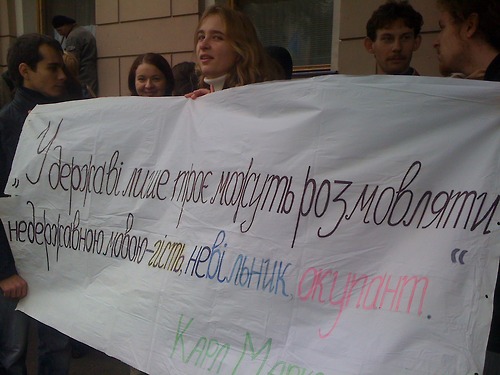
Back then, I was surprised because the quote was attributed to Karl Marx, of all people.
Here's what I wrote about it on my Tumblr blog (now deserted; three more pics from that rally - here, here, here):
[...] The quote on the poster that these young people are holding is allegedly from Karl Marx. The main idea of the quote is that it’s okay only for “a guest, a slave and an occupier” to be speaking a language that’s not the official language of the state they are in.
I think it’s ironic that they would need Marx to help them defend the Ukrainian language. A friend’s explanation that this is a neo-Marxist thing doesn’t make much sense to me. I even thought it was some kind of a joke that I didn’t get, but this friend of mine - a Ukrainian poet, among other things - doesn’t think so.
Before translating this quote here, I decided to search for the original - and ended up reading through a whole bunch of Marx & Engels stuff, for the first time in my life (I was a bad student back in the Soviet times when, I guess, we were supposed to read all that). I’ve discovered many interesting things (seriously) - but failed to find the source of the quote. Failed to find any mention of it in English, too.
Moreover, it seems to be only found online in the context of the ‘language issue’ in Ukraine. At least once, they used a variation of this quote at a pro-Ukrainian rally in Lviv. The wording differs from site to site, and a more democratic rendition says that those who cannot speak the state language of the country they are in are either guests, slaves or occupiers.
If there are any Marxists or Marx experts reading this, or just someone who is better at searching than I am, please help me find out whether Marx really said this and, if he did, where - and also what the original wording was. I’m really, really curious. [...]
And now I'm very curious again: who said it first - and how did the original sound???
A note on the ancient prejudices, misperceptions, hatreds...
I'm reading Ian Buruma's Inventing Japan: 1853-1964 now (on Kindle - yay!!!), and here's a tiny insight on how Europeans were viewed in Japan sometime in the 17th century:
It reminded me of what I had read about a Ukrainian view of the Tatars, in a novel about Roksolana/Hürrem Sultan, written by Osyp Nazaruk (I haven't finished it; another novel about Roksolana, by Pavlo Zahrebelnyi, I also have not finished - regret it, in both cases):
And the author's short annotation to this passage:
I'm reading Ian Buruma's Inventing Japan: 1853-1964 now (on Kindle - yay!!!), and here's a tiny insight on how Europeans were viewed in Japan sometime in the 17th century:
The popular image of the Dutch was that of exotic beasts, who lifted their legs, like dogs, when they relieved themselves.
It reminded me of what I had read about a Ukrainian view of the Tatars, in a novel about Roksolana/Hürrem Sultan, written by Osyp Nazaruk (I haven't finished it; another novel about Roksolana, by Pavlo Zahrebelnyi, I also have not finished - regret it, in both cases):
Розуміла, що прийдеться їй стати невольницею або, може, жінкою одної з тих брудних потворів, про які ще вдома оповідала їй бабуня, що вони родяться сліпі, як собаки.
***
She understood that she'd be forced to become a slave or, perhaps, a wife of one of those dirty monsters, who, her grandma used to tell her still back at home, were born blind, like dogs.
And the author's short annotation to this passage:
Автентичне повір'я нашого народу про татар.
***
Our people's authentic belief about the Tatars.
Subscribe to:
Posts (Atom)