[...] Alex's contract was not incredibly lucrative. In Iraq, he earned between $150 and $180 per day, sometimes $200. It puts Ukrainians in the same league as the "third-country nationals"—Nepalese, Filipinos, and Fijians—who work in the private security industry.
Earning $150 per day may not seem worth the risk—but it's a fortune in economically stagnant Ukraine. Assuming the average Ukrainian earns an official wage of $120 per month (estimates of real income are hard to come by, but that's the figure the IMF cites in a 2005 report), Alex was earning more in a day than most of his fellow countrymen earn in a month.
How much does an American make working on a private security detail in Iraq? Returning from a recent trip to Iraq, I met one U.S. security contractor in a transit hotel in Jordan. He was waiting for his baggage to arrive, and we got acquainted while waiting to check e-mail. He logged onto his account.
"Damn!" he said out loud. "I just got another job offer: $850 a day. Damn! That's a hell of a job offer." [...]
Thursday, February 09, 2006
A very interesting piece in Slate about a Ukrainian private security contractor who spent a year working in Iraq - Kalashnikovs for Hire in Iraq, by Nathan Hodge:

Wednesday, February 08, 2006
Via bad_kissinger's Journal - this:

World Religion Action Kit
World Religion Action Kit
In times of religious strife, BE READY!
This easy-to-use kit allows you to take a more active part in the present "Clash of Civilizations". No matter what your faith is, you can enjoy the flexibility offered by the four great religions – the Bible, Teachings of Buddha, Koran and Talmud in one handy box. Use them as you see fit: study them, choose sides, employ Parts A, B and C to demonstrate your loyalty to the advancing enemy troops.
Coming soon: Polytheistic Extension Kit
Tuesday, February 07, 2006
Once a dissident, always a dissident...
Via LaurenceJarvikOnline, this UPI story:
This is likely to piss off not just some 20 million Russian Muslims, but president Putin as well, now that he has condemned the publication of the Danish cartoons.
Via LaurenceJarvikOnline, this UPI story:
Moscow museum to exhibit Mohammed cartoons
MOSCOW, Feb. 7 (UPI) -- A Moscow museum has announced it will exhibit the entire series of cartoons of Mohammed that have caused riots throughout the Islamic world.
Yury Samodurov, director of the Sakharov Museum and Public Center, said on Russian television that the center was ready to organize a public exhibition of the cartoons satirizing the founder of Islam that originally were published in a Danish newspaper, Pravda.ru reported Monday.
"We must show the whole world that Russia goes along with Europe, that the freedom of expression is much more important for us than the dogmas of religious fanatics," Samodurov said.
The exhibition reportedly will open in March. Lawyer Yury Shmidt has said he will invite French philosopher Andre Glucksmann and French novelist Michel Houellebecq to the opening ceremony to read lectures about the threat of Islamic fundamentalism.
In 2003 the Sakharov Museum outraged many Russian Orthodox believers with the art exhibit "Be Careful -- Religion," which many felt was insulting to their beliefs.
This is likely to piss off not just some 20 million Russian Muslims, but president Putin as well, now that he has condemned the publication of the Danish cartoons.
Ramzan Kadyrov, the acting premier of Chechnya, is being emotional and irrational, too. And pretty independent:
One of these organizations is the Danish Refugee Council, which, according to RFE/RL, has been in the Caucasus region for seven years and "says it distributes food to 250,000 people in the region each month."
Here's the reaction of the Russian Duma folks:
I wonder whose side those hungry 250,000 refugees are on and what they are saying on the issue in the privacy of whatever it is they live in.
We've banned everything that's coming from [Denmark] and they won't be in our republic. [...] As for Danish organizations present here, we won't grant them access anymore because of this.
One of these organizations is the Danish Refugee Council, which, according to RFE/RL, has been in the Caucasus region for seven years and "says it distributes food to 250,000 people in the region each month."
Here's the reaction of the Russian Duma folks:
[...] Boris Gryzlov, the speaker of Russia's State Duma, the lower house of parliament, said he believed Acting Prime Minister Ramzan Kadyrov was expressing his personal opinion, noting that the Chechen government has made no official decision as yet.
"I think such statements should be at least passed through an official governing body first," Gryzlov said. "I view it only as a personal statement."
Pavel Krasheninnikov, the head of the Duma's legislative committee, said the ban would run counter to Russian legislation. [...]
I wonder whose side those hungry 250,000 refugees are on and what they are saying on the issue in the privacy of whatever it is they live in.
I haven't really watched TV since last year: the TV set's in the other room, and if I want noise, I can always wake Marta up and then refuse to feed her. So I'm only aware of the Danish cartoons scandal thanks to the media headlines and blogs. Reading beyond headlines is something I often choose to skip; as for my reading of the blogs, I read them selectively, and the ones I do read often supply me with a distorted view of the world: right now, it appears as if there are only sane people on both sides of the controversy.
Below is what my world sounds like, sort of. (I don't want reality checks, so I often skip comment sections, if I don't like what's there.)
Haroon Moghul of avari/nameh in the United States:
BBCD of British Born Confused Desi in Britain:
Allison Kaplan Sommer of An Unsealed Room in Israel:
Qatar Cat of Life in Qatar, or When everything else fails... in Qatar:
Mahmood Al Yousif of Mahmoud's Den in Bahrain:
This last one - just like the Russian-Ukrainian gas crisis - shows how interconnected everything is.
Below is what my world sounds like, sort of. (I don't want reality checks, so I often skip comment sections, if I don't like what's there.)
Haroon Moghul of avari/nameh in the United States:
sour danish
[...] The cartoons that are being celebrated by a certain segment of Europe go to the heart of a cultural and social clash: European secularists of a certain variety want Muslims to accept that their religion can be insulted; until Muslims accept what is sacred about Europe... which is the right to insult what is sacred about Islam... You see, I think, the dilemma.
Let us also not forget that tens of thousands of Muslims were butchered in Bosnia about a dozen years ago, and that many of the European nations that chastise the United States for its double standards, failed to act to try to contain the violence; indeed, some European leaders even associated then-President of Bosnia, Alija Izetbegovic, with fundamentalism, which is egregiously wrong, but also egregiously immoral: That doesn't justify permitting genocide to happen under one's nose. So, while I agree that Muslims certainly should not turn to violence, threats of violence, and the like, in their protesting these caricatures, one must also keep in mind that many Muslims probably feel like there is a great European double-standard when it comes to the lives and values of Muslims, and here is just one more instance of Muslim values being stepped on.
BBCD of British Born Confused Desi in Britain:
Danish bullshit
This whole thing with the Danish paper, *sigh* being a Muslim I get that side of the argument, I understand why Muslims are deeply offended as the man we believe to be our Prophet and messenger of God had been depicted in a disgusting and degrading way. What I don’t understand is why non Muslims want to do that? So apparently its about freedom of press..umm ok, with you so far…. And what? Freedom of press for what purpose? What are you achieving or trying to ascertain by printing something like that? Freedom of press is a feeble excuse to hide behind. Ok so we live in a democracy (ish).. but surely the point of a democracy is not to use it to subjugate others to mental torment and suffering. Isn’t that what dictators do, create an environment which is highly basis and unwelcoming to “others”. [...]
Allison Kaplan Sommer of An Unsealed Room in Israel:
Hand the Israelis a Danish
Following Danish cartoon flap -- and with so many European countries reprinting them to show solidarity -- let us remember that there is one western democracy which has a solid legal record of keeping Mohammed's image sacred.
So if offended Moslems want a country that truly understands them -- they should come to Israel.
Does anyone remember Tatiana Soskin? She went to jail for drawing an offensive cartoon depicting the prophet (and posting it on the door of an Arab's shop)
-----
In 1997, Tatiana Soskin was convicted by the Jerusalem District Court of offending religious sensitivities and sentenced to two years in jail and a one-year suspended sentence. Soskin was apprehended in Hebron while carrying a flyer depicting a pig wrapped in a kaffiyeh treading on an open book. The word, "Mohammed," was written on the pig and "Koran" was written on the book.
Supreme Court Justice Theodor Or rejected Soskin's appeal despite the ostensible blow to freedom of expression, ruling that "a position whereby every expression that has the potential to offend religious sensitivities will be considered a crime according to this law undermines the basic right to freedom of expression."
Or decided to apply the section banning offending religious sensitivities, but limited it. He ruled that not every serious offense is to be considered prohibited, rather only one that causes damage to the "interests of the members of that particular religion as a whole, as opposed to damage to the religious sensitivities of a given individual or another."
-----
The excerpt above comes from an article in Ha'aretz that is very interesting to read over in wake of the whole Denmark controversy.
It is a summary of a session at a Comics, Caricatures and Animation Festival that was held in Tel Aviv. The session was called "God on the Line" and participants discussed whether and to what extent cartoonists should take on religion.
After the Soskin incident, there were no calls for an Arab boycott of Israel.
Oops, that's because there already was.
Well, it's a good thing that Moslem countries don't have a record of publishing offensive cartoons.
Oops again.
***
Now Here's An Appropriate Response
What's the appropriate response when someone publishes cartoons that offend you?
Why, by publishing cartoons that offend someone else!
That'll show 'em, right?
-----
A Belgian-Dutch Islamic political organization posted anti-Jewish cartoons on its website in response to the cartoons of the prophet Muhammad that appeared in Danish papers last year and offended many Muslims.
The cartoons were posted on the Arab European League's site on Saturday. It was not working Sunday morning because of exceeded bandwidth.
The site carried a disclaimer saying the images were being shown as part of an exercise in free speech rather than to endorse their content - just as European newspapers have reprinted the Danish cartoons.
One of the AEL cartoons displayed an image of famed Dutch Holocaust victim Anne Frank in bed with Adolf Hitler, and another questioned whether the Holocaust actually occurred.
-----
The point? To decry what they see as a double standard, where denying the Holocaust is illegal under most European hate speech laws, but that everyone is defending and reprinting the Danish cartoons. Never mind that the hate speech laws are very rarely enforced. It's not as if people are getting sent to jail every year for Holocaust denial.
It's not very surprising that the Jews are getting dragged into it, despite the decision of the Israeli Foreign Ministry to stay neutral on the issue.
-----
The Israeli Foreign Ministry, which over the years has often protested anti-Semitic political cartoons in the Islamic world, stayed true to its policy regarding the Danish newspaper cartoon controversy and refused to issue a response.
One ministry official said that the "cartoon wars" were not Israel's battle, and that it did not want to get dragged into it. If Israel would react to the whole controversy, the official said, the Islamic world would eventually blame Israel for being behind the whole incident.
-----
As if they won't figure out a way to blame us anyway....
Qatar Cat of Life in Qatar, or When everything else fails... in Qatar:
Political post #2
I swear I was going to stay out of it. I said to myself that this is not my problem, not my call, not my issue. But I was drawn into it and now I just can't remain silent. Yes, it's about those infamous Danish cartoons. I am sure that “Danish cartoons” is a household expression now in many places around the world.
Now before I go any further, I want to declare for my personal safety and for my friends' peace of mind that I DO NOT SUPPORT those cartoons. Nor would I agree with anyone who uses the right of free speech to insult others in any way. Therefore I will not publish or link to them or any such material on my blog, ever. I am a very tolerant, understanding and willing to learn white western infidel if there ever was one. So please save the cheers of support and the death threats.
How come I am writing about it now?
Today I went shopping for groceries (a rather rare occurrence) and I discovered that Danish and Norwegian products are now banned from the shelves of a leading supermarket! I stood there dumbstruck. Why am I being punished? What have I done to be denied my favourite brands? And most importantly, what have the producers of these brands in Denmark and Norway done to be treated like that?
What happened to allocating the blame and punishment where appropriate? I am yet to hear the King of Saudi apologising for the actions of Saudi suicide bombers. I am yet to hear the apologies of Mr. Bush over there, and Mr. Osama over here. Why then would someone expect the Queen of Denmark to apologise for the actions of some cartoonists and one editor?? Aren't their (the cartoonists and the newspaper in general) apologies enough? And who is going to apologise to me personally for denying me my Royal Danish?
When 9/11 happened, I heard from many Muslim friends of mine that we shouldn't judge the whole religion and all the Islamic world for the actions of select few individuals. That Islam is the religion of tolerance and peace. So how come the whole nations of Denmark and Norway are now being judged for the actions of less than 20 people? Scores of these innocent people have already lost their jobs due to the products boycott in the Muslim countries. Some were assaulted and threatened. Is this the right approach? What do Muslims around the world expect to get in return? That the West acknowledges the mistake and learns the lesson? I somehow doubt it. I doubt it because the means to achieve it are wrong. You don't teach such a lesson by spreading death threats right, left and centre. Yes, the newspaper people might have apologised, but they did not necessarily understand your reasons why they were forced to do it in the first place. [...]
Mahmood Al Yousif of Mahmoud's Den in Bahrain:
Time to boycott France!
-----
A French newspaper reprinted on Wednesday a series of 12 Danish newspaper cartoons depicting the Prophet Mohammad that have sparked protests in the Muslim world and prompted Saudi Arabia to recall its ambassador from Denmark.
The France Soir daily said it had published the cartoons in the name of freedom of expression and to fight religious intolerance, saying a secular country like France could not be bound by the precepts of any religion.
Reuters
-----
Now what? You're going to boycott the F1 because Renault takes part in it? Stop buying French cars, technology, cheese? All of the above? Any one particular product? Wine boycott maybe?
Well, before you go jump off a cliff, I hope you realise that France Soir is owned by an Egyptian: Ramy Lakah, so we might as well boycott Egypt too! But as Egypt has no product to call its own, other than oil in the Sinai, reeds and some stones which belonged to the Kuffar of old, then I have no problem lumping it in the same pot as Norway, Denmark, and France.
So my prediction has come true! Don't play with fire guys, let it go, for goodness' sake let it go. This is not doing us as a nation any good at all. It just demonstrates our intolerance... but that's nothing new now is it.
NEXT!
This last one - just like the Russian-Ukrainian gas crisis - shows how interconnected everything is.
Monday, February 06, 2006
I've just posted an overview of the Russian blogosphere on Global Voices Online and am totally wiped out.
Saturday, February 04, 2006
One of those rare cases when I have to make a huge effort in order not to cry over a New York Times story. A travel story.
Emerging From the Shadow of War, Sarajevo Slowly Reclaims Its Lost Innocence, by Christopher Solomon:
***
I wanted to run away to Sarajevo a year ago, but instead I got pregnant and now I have Marta.
Emerging From the Shadow of War, Sarajevo Slowly Reclaims Its Lost Innocence, by Christopher Solomon:
[...]
Fikret Kahrovic was in the militia defending the city, but he does not offer much about the war, in a way that makes me think he could say plenty. He used to be angry all the time, he says, but not anymore.
"It was," he says, "like a very old and very bad movie that you watched once upon a time." His voice seems flat, affectless.
[...]
And ordnance. From the countless shells that had rained on Sarajevo, the craftsman had stamped flower vases. Bullets had become ballpoint pens that read "Bosnia."
[...]
Among the war's many small cruelties was how it forced residents to loathe their beloved hills; the snipers watched from those hills.
Now the city has its views back.
Sometimes, rounding a corner on a snowy afternoon, I would look up to catch a shard of sunshine passing over white roofs on the steep, snow-covered hillsides above the city, and black pines disappearing into low clouds — a glimpse of Switzerland strung between minaret and bullet-pocked cornice. [...]
***
I wanted to run away to Sarajevo a year ago, but instead I got pregnant and now I have Marta.
Wow, this is cool: via Global Voices Online, I've just found a whole bunch of blogs from Antarctica!
Suddenly, I want valenki.
Last time I wore them was, like, a quarter of a century ago, in kindergarten. Last time I paid attention to someone wearing them was in 1995, in the slush of one Kyiv market, where I saw an old village woman who must've been so poor she couldn't afford rubber galoshi, so she wrapped her feet in plastic bags instead, a very sad sight.
But today I saw a small item in Moscow's Afisha - about a store called Russkiye Valenki, on Varshavskoye Shosse, where you can buy valenki of all kinds, from the simplest traditional to the cute ones with embroidery, and even with tiny bells on them. Kids' valenki, too, for 6-month-olds and older. Prices range from 200 to 700 rubles (roughly $5 to $25).
Then I ran into this English-language site, Valenkis'Rus, where you can buy traditional-style valenki for $70.
This valenki-mania reminds me of how shalwar kameez suddenly became popular after Princess Diana had been seen wearing one sometime in 1995 or 1996. Even more, it reminds me of how I unexpectedly fell in love with Ukrainian embroidered blouses, vyshyvanky, also in 1995.
Finally, it may sound crazy, but you can wear valenki indoors - when it's cold. I wrote Mishah about it, and he laughed at me, but that's okay, because he was in our hot Moscow apartment when I was freezing here in Kyiv, so what does he know. Even a wonderful Soviet actress Rufina Nifontova (1931-1994) used to wear valenki at home sometimes. Valenki and a striped sailor's shirt.
Last time I wore them was, like, a quarter of a century ago, in kindergarten. Last time I paid attention to someone wearing them was in 1995, in the slush of one Kyiv market, where I saw an old village woman who must've been so poor she couldn't afford rubber galoshi, so she wrapped her feet in plastic bags instead, a very sad sight.
But today I saw a small item in Moscow's Afisha - about a store called Russkiye Valenki, on Varshavskoye Shosse, where you can buy valenki of all kinds, from the simplest traditional to the cute ones with embroidery, and even with tiny bells on them. Kids' valenki, too, for 6-month-olds and older. Prices range from 200 to 700 rubles (roughly $5 to $25).
Then I ran into this English-language site, Valenkis'Rus, where you can buy traditional-style valenki for $70.
This valenki-mania reminds me of how shalwar kameez suddenly became popular after Princess Diana had been seen wearing one sometime in 1995 or 1996. Even more, it reminds me of how I unexpectedly fell in love with Ukrainian embroidered blouses, vyshyvanky, also in 1995.
Finally, it may sound crazy, but you can wear valenki indoors - when it's cold. I wrote Mishah about it, and he laughed at me, but that's okay, because he was in our hot Moscow apartment when I was freezing here in Kyiv, so what does he know. Even a wonderful Soviet actress Rufina Nifontova (1931-1994) used to wear valenki at home sometimes. Valenki and a striped sailor's shirt.
Friday, February 03, 2006
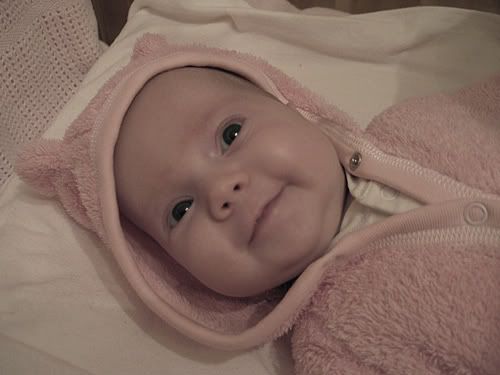
Somehow, I feel that everyone should know about it: Marta has allowed me five hours of sleep in a row for the first time in two months today!!! She woke me up at 5:20 am, and I feel so rested, I can write a novel now!
Also, I think I forgot to mention it earlier: she's smiling more and more now, and her smiles no longer look accidental!
***
Marta and I had our longest walk Feb. 2: an hour and 45 minutes.
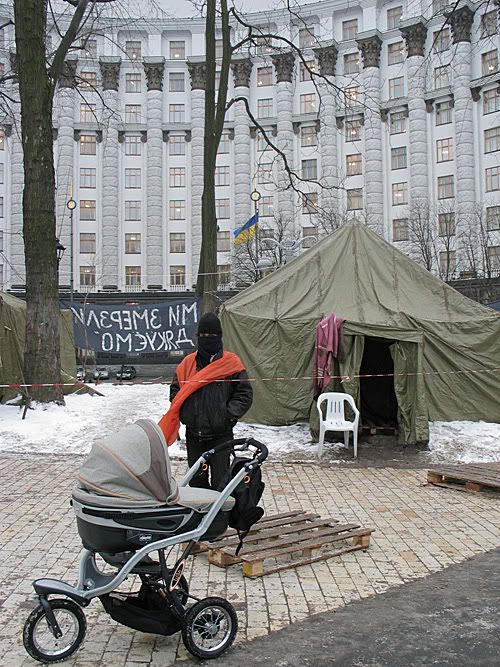
Mariinsky Park has turned into a protest site again and reminded me of both 2004 (because it is cold) and of 2005 (because there're too few protesters, and though they're visible and extremely loud, they don't look too genuine, just like Yanukovych supporters didn't back in May 2005).
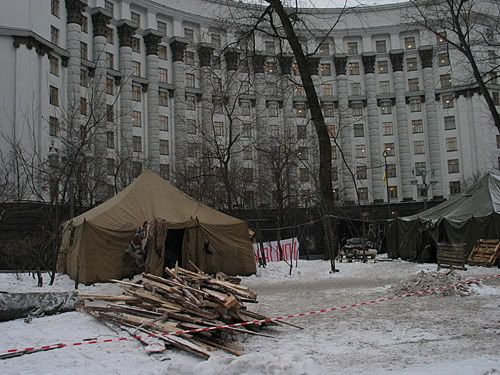
A boy by the tents told me they were from a group called the Veterans of Maidan and were protesting the gas deal with Russia. He didn't look like someone who'd know much about the subject, though - and he was obviously very, very cold.
Also, I think I forgot to mention it earlier: she's smiling more and more now, and her smiles no longer look accidental!
***
Marta and I had our longest walk Feb. 2: an hour and 45 minutes.
Mariinsky Park has turned into a protest site again and reminded me of both 2004 (because it is cold) and of 2005 (because there're too few protesters, and though they're visible and extremely loud, they don't look too genuine, just like Yanukovych supporters didn't back in May 2005).
A boy by the tents told me they were from a group called the Veterans of Maidan and were protesting the gas deal with Russia. He didn't look like someone who'd know much about the subject, though - and he was obviously very, very cold.
Thursday, February 02, 2006
Marta is 2 months old - hard to believe, isn't it?
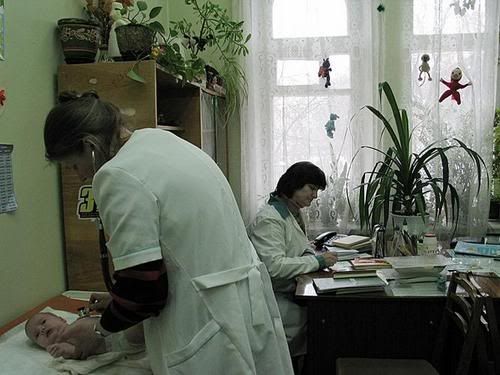
So we went to see the doctors today/yesterday, and everything's okay, more or less. Marta's grown (5 kilos and 56 centimeters; last time, on Jan. 4, she was 4.3 kilos and 53 centimeters), but there's a tiny problem with her left eye and a potentially serious problem with her left hip. Or there aren't any problems and the doctors are just trying to sell us certain medicines and medical devices to get a commission. You never know here. I'll seek second opinion and, possibly, third and fourth and fifth opinions. I don't want to get into it here and now, because it's making me terribly nervous.
Mishah's in Moscow, so I was aided by my mama. I took some pictures at the clinic again - they are here.
Our doctor examining Marta and our nurse sitting at her desk:
And this is my favorite photo, from the ortopedicians' room:
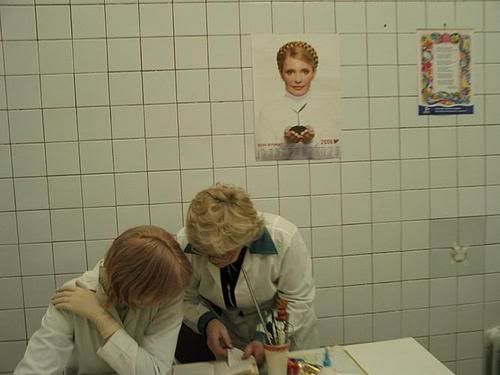
So we went to see the doctors today/yesterday, and everything's okay, more or less. Marta's grown (5 kilos and 56 centimeters; last time, on Jan. 4, she was 4.3 kilos and 53 centimeters), but there's a tiny problem with her left eye and a potentially serious problem with her left hip. Or there aren't any problems and the doctors are just trying to sell us certain medicines and medical devices to get a commission. You never know here. I'll seek second opinion and, possibly, third and fourth and fifth opinions. I don't want to get into it here and now, because it's making me terribly nervous.
Mishah's in Moscow, so I was aided by my mama. I took some pictures at the clinic again - they are here.
Our doctor examining Marta and our nurse sitting at her desk:
And this is my favorite photo, from the ortopedicians' room:
The New York Times runs another piece on the newly-published wartime collection by Vasily Grossman, A Writer at War (my post on the first review is here):
I want to have this book.
[...]
As a journalist, he is not embedded — to use the contemporary phrase — among soldiers as a representative of a free press in a civilian society. There is no free press. Civilians are only those who will be killed without weapons in their hands, and who have already been brutalized by Stalin before the war. Grossman is not free himself. He is all but a soldier under orders. Yet he is forced to sustain the consciousness needed to record everything he sees around him. His survival, after four years of war, is as miraculous as the survival of Kuznechik, the Bactrian camel that accompanied the 308th Rifle Division from Stalingrad to Berlin, where it spat on the Reichstag.
[...]
I want to have this book.
Wednesday, February 01, 2006
Political analyst Volodymyr Polokhalo gets quoted everywhere all the time. Most recently I've seen him in a Korrespondent.net piece (in Russian): he was citing "three strategic mistakes" that led Yushchenko to lose much of his credibility. According to Polokhalo, the first mistake was giving Petro Poroshenko too much power, the second was firing Yulia Tymoshenko's government, and the third was signing a memorandum with Victor Yanukovych. Additionally, he noted the inconsistency of Yushchenko's foreign policy - "...he aspires to be in Europe, but makes his first visit to Russia" - and called the appointment of Yuri Yekhanurov's government "a conspiracy between Yushchenko and the oligarchs."
Polokhalo also appears a few times in the recent New York Times Magazine piece about Tymoshenko:
It's all very nice, and I do agree with some of what Polokhalo says about Yushchenko's mistakes, but there is one little thing that both the New York Times and Korrespondent.net keep silent about: that Volodymyr Polokhalo isn't just a political analyst, but candidate #50 with Yulia Tymoshenko's Bloc.
All political analysts seem to have biases and preferences - but running for parliament makes Polokhalo a politician, and it's really annoying when he's not identified as such.
***
Another well-known political analyst turned politician is Dmytro Vydrin: he's #92 on Yulia Tymoshenko's Bloc's list.
Polokhalo also appears a few times in the recent New York Times Magazine piece about Tymoshenko:
[...] Volodymyr Polokhalo, a political analyst in Kiev, gives Tymoshenko an even chance of again becoming prime minister this spring. And if she doesn't, he gives her a 70 percent chance of becoming Ukraine's next president in 2009.
[...]
By her mid-30's, the daughter of a single mother who had toiled on Dnipropetrovsk's trolley system had become Eastern Europe's one and only "lady oligarch." Whether UESU dealings were "illegal" by the Wild East standards of the ex-Soviet Union in the 1990's - the political analyst Volodymyr Polokhalo speaks of the "total corruption" of the era - is a difficult question.
[...]
Because she knew its tricks, Tymoshenko proved an effective reformer of Ukraine's lucrative and filthy energy sector - perhaps too effective. Her brash reforms brought a huge tranche of Ukraine's shadow economy into the light. But her assaults on the prerogatives of Ukraine's crooked energy titans, her former peers, made her an irritant to the regime. She had to go. In mid-January 2001, Ukraine's top prosecutor accused her of having engaged in extortion, money laundering and other crimes while heading UESU. The charges, Polokhalo, the analyst, says, had an obvious "political character." "You could bring such charges against all the big businessmen of the 1990's," he explains. Kuchma fired her that same month.
[...]
At home, too, she has until recently been dogged by what Polokhalo calls politically motivated investigations into long-past supposed misdeeds. The last of the investigations were closed only six weeks ago, when a Kiev court dismissed them for lack of evidence. [...]
It's all very nice, and I do agree with some of what Polokhalo says about Yushchenko's mistakes, but there is one little thing that both the New York Times and Korrespondent.net keep silent about: that Volodymyr Polokhalo isn't just a political analyst, but candidate #50 with Yulia Tymoshenko's Bloc.
All political analysts seem to have biases and preferences - but running for parliament makes Polokhalo a politician, and it's really annoying when he's not identified as such.
***
Another well-known political analyst turned politician is Dmytro Vydrin: he's #92 on Yulia Tymoshenko's Bloc's list.
Mustafa Jemilev, leader of the Crimean Tatars, is #45 on the list of candidates from the "Our Ukraine" Bloc. In his brief bio on the Central Election Commission site, it says he resides in Kyiv.
Yulia Tymoshenko, on the other hand, lives in Dnipropetrovsk, according to the same source.
Go figure.
Yulia Tymoshenko, on the other hand, lives in Dnipropetrovsk, according to the same source.
Go figure.
One of my favorite books has been translated into English: Kornei Chukovsky's Diary, 1901-1969 (a huge thanks for the tip to Languor Management).
Here's an Amazon.com description:
There are several editions of the diary in Russian, and I've got one and a half: the older one is missing the second volume - they were being sold separately, I guess - and I've been told that the one I've got is harder to find than the one I haven't. Excerpts from the diary were published in several issues of Novyi Mir in the early 1990s - I've got those somewhere as well. Actually, I was digging through the old magazines in 2001, ran into the diary in Novyi Mir, got hooked and suddenly remembered we had a hardcover edition somewhere on the shelves, found it and couldn't stop reading,
I only acquired the full two-volume edition a year or two ago, but didn't have the heart to finish the second volume: it begins with the suffering and death of Chukovsky's little daughter, and it gets sadder and sadder as Chukovsky is getting older. Not that the first volume is full of cheerful stuff: Chukovsky's notes on the early 1920s - horrible, hungry and cold - are among the most shocking and unforgettable.
***
This past summer, Mishah and I went to Peredelkino, where Chukovsky had a dacha (while in St. Pete, I tried to find his other dacha in Komarovo, but no one seemed to know where it used to be). The dacha is a museum now, tiny and wonderful, very well-kept: it seems as if Chukovsky just stepped outside for a minute and would return shortly. All his books (or many of them) are there, and there's an impressive English-language collection.
The tour of the house wasn't extremely interesting, however, partly because the woman working there as a guide was too used to showing kids around: she simplified things, there was much to add to what she was saying, and she sounded somewhat too patronizing, especially toward Mishah and me (kept saying something about the 'younger generation' while looking at us, even though she was probably my age and definitely not older than Mishah). Two women who were on this tour with us didn't know anything about Chukovsky beyond all the wonderful kids' stuff he's written, and it was quite a revelation to be reminded of how obscure Chukovsky's adult side was. These two women hadn't been aware of the museum's existence and ran into it accidentally on the way back from Boris Pasternak's dacha-museum, also located in Peredelkino (but not as interesting as Chukovsky's dacha, we were told).
***
Then there's Lidiya Chukovskaya, of course, Kornei Chukovsky's elder daughter, a Soviet dissident, author of Sofya Petrovna, one of the earliest fictional accounts of Stalin's purges, written in 1940, shortly after Chukovskaya's husband had been persecuted.
Here's an Amazon.com description:
A perceptive literary critic, a world-famous writer of witty and playful verses for children, a leading authority on children’s linguistic creativity, and a highly skilled translator, Kornei Chukovsky was a complete man of letters. As benefactor to many writers including Alexander Solzhenitsyn and Joseph Brodsky, he stood for several decades at the center of the Russian literary milieu. It is no exaggeration to claim that Chukovsky knew everyone involved in shaping the course of twentieth-century Russian literature. His voluminous diary, here translated into English for the first time, begins in prerevolutionary Russia and spans nearly the entire Soviet era. It is the candid commentary of a brilliant observer who documents fifty years of Soviet literary activity and the personal predicament of the writer under a totalitarian regime.
From descriptions of friendship with such major literary figures as Anna Akhmatova and Isaac Babel to accounts of the struggle with obtuse and hostile censorship, from the heartbreaking story of the death of the daughter who had inspired so many stories to candid political statements, the extraordinary diary of Kornei Chukovsky is a unique account of the twentieth-century Russian experience.
There are several editions of the diary in Russian, and I've got one and a half: the older one is missing the second volume - they were being sold separately, I guess - and I've been told that the one I've got is harder to find than the one I haven't. Excerpts from the diary were published in several issues of Novyi Mir in the early 1990s - I've got those somewhere as well. Actually, I was digging through the old magazines in 2001, ran into the diary in Novyi Mir, got hooked and suddenly remembered we had a hardcover edition somewhere on the shelves, found it and couldn't stop reading,
I only acquired the full two-volume edition a year or two ago, but didn't have the heart to finish the second volume: it begins with the suffering and death of Chukovsky's little daughter, and it gets sadder and sadder as Chukovsky is getting older. Not that the first volume is full of cheerful stuff: Chukovsky's notes on the early 1920s - horrible, hungry and cold - are among the most shocking and unforgettable.
***
This past summer, Mishah and I went to Peredelkino, where Chukovsky had a dacha (while in St. Pete, I tried to find his other dacha in Komarovo, but no one seemed to know where it used to be). The dacha is a museum now, tiny and wonderful, very well-kept: it seems as if Chukovsky just stepped outside for a minute and would return shortly. All his books (or many of them) are there, and there's an impressive English-language collection.
The tour of the house wasn't extremely interesting, however, partly because the woman working there as a guide was too used to showing kids around: she simplified things, there was much to add to what she was saying, and she sounded somewhat too patronizing, especially toward Mishah and me (kept saying something about the 'younger generation' while looking at us, even though she was probably my age and definitely not older than Mishah). Two women who were on this tour with us didn't know anything about Chukovsky beyond all the wonderful kids' stuff he's written, and it was quite a revelation to be reminded of how obscure Chukovsky's adult side was. These two women hadn't been aware of the museum's existence and ran into it accidentally on the way back from Boris Pasternak's dacha-museum, also located in Peredelkino (but not as interesting as Chukovsky's dacha, we were told).
***
Then there's Lidiya Chukovskaya, of course, Kornei Chukovsky's elder daughter, a Soviet dissident, author of Sofya Petrovna, one of the earliest fictional accounts of Stalin's purges, written in 1940, shortly after Chukovskaya's husband had been persecuted.
Subscribe to:
Posts (Atom)