Random thoughts.
Sometimes I care only about Kyiv. Sometimes I can't bring myself to care about any other place in Ukraine but Kyiv. What happened there in February, what went on there between March and now, and what's still to come. Sometimes nothing else but this matters.
And then sometimes I realize I have it in me to care about other places as well.
Donetsk.
I've been there a few times in the past. It wasn't always nice. Actually, the city felt alive only once when I was there - ordinary, normal, happy. FC Shakhtar was playing Lazio that day; Google says it was Sept. 12, 2000. Shakhtar played beautifully, but lost 0:3. They played beautifully in between those three goals. And before they lost, they city had been alive, there were many people out in the streets, happy and hopeful. I don't know, maybe it was like this many times before and after Sept. 12, 2000, but I wasn't there. I'm sure it wasn't an ugly place during the UEFA Euro 2012. I hope it wasn't.
And I remember the doctors from Donetsk region that we got to interview back then. One of them more than others. He used to work with coal miners - with their lungs, that is. He told us some really scary things about those coal miners' lungs. I remember how shocked I was when I saw that doctor go out for a smoke into the hallway of the Nadezhda Krupskaya library. Those lungs he sees every day at work - and he's a smoker? I wish I remembered his name. I hope he's still around, safe.
In Moscow, I know one woman from Donetsk. Her husband was a coal miner, he died very young in a mine explosion, leaving her with their little daughter. The daughter's name, Luiza, always makes me think of a little bit of sunshine that someone accidentally allowed to enter into an otherwise dreadful place. I wouldn't want to talk about politics with this woman - I tried once, sometime in April, and it felt surreal. She's one of those people who believes what the Russian TV is telling her. She was not bloodthirsty at all. But she was scared - when it wasn't scary at all yet - and fear does make some people bloodthirsty. Not her, I hope. She works with kids, she cannot afford to be bloodthirsty. And I hope her elderly parents in Donetsk are safe. Or safely out of Donetsk by now. No matter what bullshit they believe in when it comes to politics.
And I remember how one day in 2004 people in the huge orange crowd in Kyiv were chanting "Slava shakhtaryam!" ("Glory to coal miners!"), as they stood face to face with the pro-Yanukovych crowd. Some in this pro-Yanukovych crowd turned out to be from Crimea, not from Donbas, and this chant pissed them off, for some reason. "We're not coal miners, damn it! We're from Crimea," they yelled back - but the orange guys waved them off and went on with their cheerful chant: "Ah, who the fuck cares! Slava shakhtaryam!" And soon afterwards some of the orange guys were chatting with whoever still remained from the pro-Yanukovych camp, and the Romanian TV journalist I was helping that day was running around, asking everyone what seemed like a very silly question back then: "Is there gonna be a civil war in Ukraine?" Everyone - the orange and the remaining pro-Yanukovych guys - seemed to find this question absurd. "A civil war? In Ukraine? No way! East and West are together!" Well, it's different now, ten years on. And there is a difference between Donbas and Crimea after all.
And then there is Lugansk. A place I'll never really care about, definitely not the way I care about Kyiv or even Donetsk. But one of my dear Moscow friends has a cousin there. This cousin's wife is pregnant. I hope they are out of there, safe. They - and a few more people I know who have families there.
Everyone, actually. I want everyone to be alive and safe. In one piece. I want everything to return to normal.
It's weird when you have to make such an effort to care about places in your own country. Maybe it's because of what happened in Kyiv in February. It hurts so much it makes you numb. And it mutes you. Me. It mutes me.
I know people who used to say, "Oh, screw the south-east, Donbas and Crimea, let them go to hell, to Russia." At least a few of my friends, and at least one well-known, award-winning Ukrainian author. It wasn't all that uncommon to think this way, I guess. And I used to get furious: it's never pretty when shit like this is happening for real and not just in people's heads. A humanitarian catastrophe and all that. As if we don't have enough problems with healthcare, etc. Oh, and the shit that people in those "pro-Russian" areas used to carry in their heads - somehow, I never took that seriously. Similarly, at some point I began to just take for granted the crazy stuff that the Yanukovych government was doing - nothing to discuss there - but was fuming over the mistakes of those I'd been voting for.
Enough for now. Maybe I'll write more sometime soon. It feels good to vent. Like blowing one's nose during a cold.
Monday, August 11, 2014

Friday, May 02, 2014
I'm tired of many things now, very tired in general, have only slept through the night twice since January 19, when the protests at Hrushevskogo began and I was so far away from Kyiv. I still am. Which is tough. But I can't help it.
One of the things I'm tired of now is Facebook. It's too crowded for me, I'm tired of always feeling as if I'm addressing someone when I write there. I've never been fond of public speaking.
Writing here, on the other hand, used to feel sort of private, somehow. A room of my own. I liked to show it off, of course, loved to have guests around, but it was still mine alone. And in real life, I've become very territorial over the past few years - must be how this age thing is affecting me. So I guess I'll migrate back here for a while. Not sure if it's gonna work, not sure if it makes me feel better, but I'll give it a try.
Actually, I already feel better - because I missed this blog, felt guilty for having deserted it - and now I've returned, and can talk to myself out loud all I want, whenever I feel like it.
One of the things I'm tired of now is Facebook. It's too crowded for me, I'm tired of always feeling as if I'm addressing someone when I write there. I've never been fond of public speaking.
Writing here, on the other hand, used to feel sort of private, somehow. A room of my own. I liked to show it off, of course, loved to have guests around, but it was still mine alone. And in real life, I've become very territorial over the past few years - must be how this age thing is affecting me. So I guess I'll migrate back here for a while. Not sure if it's gonna work, not sure if it makes me feel better, but I'll give it a try.
Actually, I already feel better - because I missed this blog, felt guilty for having deserted it - and now I've returned, and can talk to myself out loud all I want, whenever I feel like it.
Saturday, December 29, 2012
2 AM, Friday-to-Saturday night. Cihangir, Istanbul.
I've just spent over half an hour watching an absolutely awesome bus rescue operation on our narrow street.
Two guys - I guess they were just two random guys, neat, casually dressed, driving home from some party perhaps - directed two buses that were unable to pass through a curved segment of the road.
The two guys dismantled and dragged away part of the pavement border - large, heavy stones that would've damaged the buses - and then they were yelling directions to the bus drivers - and also making sure that the numerous cabs and other vehicles driving past them up and down the only available - and curved - lane didn't collide...
First one bus, then the other.


Then they spent 15 more minutes putting the pavement border stones back. They probably didn't have to: there's some construction going on here, they could've left the mess for construction workers to clean up tomorrow - but they didn't.
Truly amazing.
Somewhat sad that none of the cars driving by stopped, that no one got out to help these guys, but it doesn't really matter: there was more than enough brotherly spirit, definitely much more than I've seen back in our part of the world in a long time.
I wasn't the only one watching the operation: an upstairs neighbor smoked four cigarettes while the first bus was being led to freedom - I saw the butts fly down past my window, all four of them.
I was filming it all, but I doubt I'll ever post this footage anywhere: too long, too dark - and I've already killed all the suspense. Those guys are heroes, period.
Istanbul's random, unsung, anonymous heroes. If I were a guy, I'd like to be like them :)
I've just spent over half an hour watching an absolutely awesome bus rescue operation on our narrow street.
Two guys - I guess they were just two random guys, neat, casually dressed, driving home from some party perhaps - directed two buses that were unable to pass through a curved segment of the road.
The two guys dismantled and dragged away part of the pavement border - large, heavy stones that would've damaged the buses - and then they were yelling directions to the bus drivers - and also making sure that the numerous cabs and other vehicles driving past them up and down the only available - and curved - lane didn't collide...
First one bus, then the other.


Then they spent 15 more minutes putting the pavement border stones back. They probably didn't have to: there's some construction going on here, they could've left the mess for construction workers to clean up tomorrow - but they didn't.
Truly amazing.
Somewhat sad that none of the cars driving by stopped, that no one got out to help these guys, but it doesn't really matter: there was more than enough brotherly spirit, definitely much more than I've seen back in our part of the world in a long time.
I wasn't the only one watching the operation: an upstairs neighbor smoked four cigarettes while the first bus was being led to freedom - I saw the butts fly down past my window, all four of them.
I was filming it all, but I doubt I'll ever post this footage anywhere: too long, too dark - and I've already killed all the suspense. Those guys are heroes, period.
Istanbul's random, unsung, anonymous heroes. If I were a guy, I'd like to be like them :)
Tuesday, November 27, 2012


Thursday, November 08, 2012
Earlier this week, I took a stroll along a cordon made up of two or three rows of huge guys in black riot gear.
They were there to contain the opposition protesters inside the square in front of the Central Election Commission. They were there to intimidate these protesters - as well as those who might have been considering joining the protest against vote-rigging that night.
I walked past them, a meter or so away, at a leisurely pace, smoking a cigarette, never once turning my head to look at them.
The decision to ignore these huge guys was spontaneous, and it didn't make any sense. All of a sudden, I just felt like strolling all the way to the cordon's corner point, pretending it was just an ordinary stroll. Took me about two minutes to get there. Then I turned around and moved away, back towards to the protesters.
At one point during this stroll, I forgot that the huge guys were there. I felt as if I was walking next to a tall black fence on my right - walking all alone, in the dark.
It was a powerful, weird sensation, which didn't last too long - a dozen steps at most. I knew they were there, yet I was able to convince myself that they weren't, just by not looking at them.
But after those dozen or so steps, the huge guys' presence slowly began to be felt again. They all stood there in silence, but they were staring at me. I knew they were. The wind - and it was a windy night - was blowing the smoke from my cigarette into their faces, which was a cruel thing of me to allow.
I may have looked like someone lost in thought - but I also looked like I was teasing them.
Teasing them like that mean cat in Hayao Miyazaki's wonderful film, Whisper of the Heart: the cat that liked to drive the neighborhood dog crazy by getting itself up on a tall fence, turning its fat ass to the poor dog, and letting it try to grab its tail for a while, then getting up and continuing on its way as if nothing happened.
The cat, unlike the dog, was free to go wherever it liked. So was I, unlike those huge, armed guys.
They were there to contain the opposition protesters inside the square in front of the Central Election Commission. They were there to intimidate these protesters - as well as those who might have been considering joining the protest against vote-rigging that night.
I walked past them, a meter or so away, at a leisurely pace, smoking a cigarette, never once turning my head to look at them.
The decision to ignore these huge guys was spontaneous, and it didn't make any sense. All of a sudden, I just felt like strolling all the way to the cordon's corner point, pretending it was just an ordinary stroll. Took me about two minutes to get there. Then I turned around and moved away, back towards to the protesters.
At one point during this stroll, I forgot that the huge guys were there. I felt as if I was walking next to a tall black fence on my right - walking all alone, in the dark.
It was a powerful, weird sensation, which didn't last too long - a dozen steps at most. I knew they were there, yet I was able to convince myself that they weren't, just by not looking at them.
But after those dozen or so steps, the huge guys' presence slowly began to be felt again. They all stood there in silence, but they were staring at me. I knew they were. The wind - and it was a windy night - was blowing the smoke from my cigarette into their faces, which was a cruel thing of me to allow.
I may have looked like someone lost in thought - but I also looked like I was teasing them.
Teasing them like that mean cat in Hayao Miyazaki's wonderful film, Whisper of the Heart: the cat that liked to drive the neighborhood dog crazy by getting itself up on a tall fence, turning its fat ass to the poor dog, and letting it try to grab its tail for a while, then getting up and continuing on its way as if nothing happened.
The cat, unlike the dog, was free to go wherever it liked. So was I, unlike those huge, armed guys.
Wednesday, November 07, 2012
The only comment I've got so far on my most recent Ukraine piece for GV - which mentions Donetsk a few times - is this:

Who cares about this election and other politics when we've got our girls - even in Donetsk, it turns out.

Who cares about this election and other politics when we've got our girls - even in Donetsk, it turns out.
Woke up to the sound of communist marches outside. Explained to Marta that it's the day when people are a bit more eager to fight with each other over history and politics than on other days.
Opened the news to find that Obama's got four more years. Reacted with a gasp: they voted yesterday, and the results are already in today. Here, it's been ten days, and the results are some crazy mess, as always.
Later, when Marta mentioned she was helping other kids with origami at school, I said it was really nice of her. Then, for some reason, I decided to warn her that when she grows up a little and they start having serious tests and stuff in their classes, she shouldn't let other kids copy her work, because it's called cheating, and in the U.S., for example, they expel kids from school for it.
"Oh, I don't think I wanna study at an American school then," said Marta.
So I had to use their and our elections as an example to explain why schools that don'tallow tolerate cheating are better than those that do.
Without any cheating, it takes so much faster to cast and count the votes, determine the winner and move on with life.
In Ukraine, however, all this cheating leaves no room for life whatsoever: few things get done properly, because they're all very busy trying to make you believe that their guy is the true winner, and then it's time for a new election, and it all starts all over again - all, including the cheating.
I think Marta found this explanation pretty convincing.
Opened the news to find that Obama's got four more years. Reacted with a gasp: they voted yesterday, and the results are already in today. Here, it's been ten days, and the results are some crazy mess, as always.
Later, when Marta mentioned she was helping other kids with origami at school, I said it was really nice of her. Then, for some reason, I decided to warn her that when she grows up a little and they start having serious tests and stuff in their classes, she shouldn't let other kids copy her work, because it's called cheating, and in the U.S., for example, they expel kids from school for it.
"Oh, I don't think I wanna study at an American school then," said Marta.
So I had to use their and our elections as an example to explain why schools that don't
Without any cheating, it takes so much faster to cast and count the votes, determine the winner and move on with life.
In Ukraine, however, all this cheating leaves no room for life whatsoever: few things get done properly, because they're all very busy trying to make you believe that their guy is the true winner, and then it's time for a new election, and it all starts all over again - all, including the cheating.
I think Marta found this explanation pretty convincing.
Sunday, October 28, 2012
Here's something to encourage myself to get up and go to the polling station:
Refat Chubarov, #111 on the United Opposition list, speaking Crimean Tatar, Russian and Ukrainian in the Crimean Parliament. I wish more of our politicians were like him.
Such a shame that he's #111, he should be much higher up - he has to be in the Parliament - and so I've decided to vote for the United Opposition because of him - and not for Klitschko's Udar - to help him get in.
Refat Chubarov, #111 on the United Opposition list, speaking Crimean Tatar, Russian and Ukrainian in the Crimean Parliament. I wish more of our politicians were like him.
Such a shame that he's #111, he should be much higher up - he has to be in the Parliament - and so I've decided to vote for the United Opposition because of him - and not for Klitschko's Udar - to help him get in.
Saturday, October 27, 2012
Too many elections since 2004 - since Maidan - but not much effect.
Interesting to think of how optimistic some of us were eight years ago.
Sad to think of all the crushed hopes - especially the hopes of those of us who were more idealistic and naive than others.
Frustrating to think of the incurable public amnesia that we seem to be infected with - we keep voting for exactly the same people, keep pretending to expect them to deliver on the promises they've been making for the past 20 years or so, conveniently forget (or pretend to) about these candidates' faults ahead of each new vote.
Would be great to be able to revert to one's 20-year-old self every time there is an election here: the results are likely to be rigged and protest would seem like the only decent option - and the "younger generation" is so much better at dealing with it than the rest of us (until most of them turn into "the rest of us" themselves, that is).
In the past eight years, however, we've seen far too many 20-year-olds taking part - for a fee - in staged protests, and maybe I should finally stop generalizing about and idealizing those "new kids on the bloc"...
A strong sense of déjà vu: I've come to Kyiv to vote - will stay for two weeks or so. In 2004, I also came to Kyiv for just two weeks, but ended up staying for two months. This time I'll go back as planned.
History repeats itself, first as tragedy, then as farce: not sure about the "tragedy" part, but there's been plenty of farce lately.
The latest farcical episode - which reminded me of our seemingly legitimate fears eight years ago - features the arrival of tanks and other military vehicles at Maidan last night, a day and a half before the vote. There was some initial outrage on Facebook and elsewhere, until someone reported that the tanks were old, that they were part of a WWII-related exhibition. Then some folks chose to ignore common sense and went on screaming about the imminent bloodshed - while others discussed the all-too-obvious symbolism and timing of these antique tanks at Maidan, and the message that the bastards up above seem to be sending to the masses: don't even think of coming to Maidan with your protests on Sunday.


Interesting to think of how optimistic some of us were eight years ago.
Sad to think of all the crushed hopes - especially the hopes of those of us who were more idealistic and naive than others.
Frustrating to think of the incurable public amnesia that we seem to be infected with - we keep voting for exactly the same people, keep pretending to expect them to deliver on the promises they've been making for the past 20 years or so, conveniently forget (or pretend to) about these candidates' faults ahead of each new vote.
Would be great to be able to revert to one's 20-year-old self every time there is an election here: the results are likely to be rigged and protest would seem like the only decent option - and the "younger generation" is so much better at dealing with it than the rest of us (until most of them turn into "the rest of us" themselves, that is).
In the past eight years, however, we've seen far too many 20-year-olds taking part - for a fee - in staged protests, and maybe I should finally stop generalizing about and idealizing those "new kids on the bloc"...
A strong sense of déjà vu: I've come to Kyiv to vote - will stay for two weeks or so. In 2004, I also came to Kyiv for just two weeks, but ended up staying for two months. This time I'll go back as planned.
History repeats itself, first as tragedy, then as farce: not sure about the "tragedy" part, but there's been plenty of farce lately.
The latest farcical episode - which reminded me of our seemingly legitimate fears eight years ago - features the arrival of tanks and other military vehicles at Maidan last night, a day and a half before the vote. There was some initial outrage on Facebook and elsewhere, until someone reported that the tanks were old, that they were part of a WWII-related exhibition. Then some folks chose to ignore common sense and went on screaming about the imminent bloodshed - while others discussed the all-too-obvious symbolism and timing of these antique tanks at Maidan, and the message that the bastards up above seem to be sending to the masses: don't even think of coming to Maidan with your protests on Sunday.


Thursday, June 07, 2012
[I need more space than Twitter and Facebook are giving me. More air. I'm tired of counting characters and words when I write. I need to relax. That's why I'm back here, at least for a while.]
In the afternoon, I read this Ukrainska Pravda text [ukr] about the crazy mess on Trukhaniv Island, where the Euro 2012 camp for Swedes is (or was?) supposed to be. There're enough shocking pictures in this text to make everything clear for those who don't read Ukrainian.
Then I saw a couple of people discussing the text on Facebook, including a Swedish friend of ours. And when I went outside, I took a picture of the Swedish Corner on Khreshchatyk for him:

(As far as I can tell, everything looks okay inside the Khreshchatyk Fan Zone so far. Especially if you compare it to the rest of the city.)
Anyway, then I decided to walk to Trukhaniv Island, hoping to see something at least a little bit different from what the Ukrainska Pravda reporters had seen.
Unfortunately, everything did look pretty terrible. The camp's opening is scheduled for June 7 - but there's too much construction still going on to consider the place livable.
Right after I crossed the Pedestrian Bridge, the sky turned black and it started raining, so I had to run for shelter to the only place nearby that had some roof and some walls around it. I spent over an hour stuck there, listening, among other things, to bits of conversations of some nervous, skinny construction workers.
I have a feeling that they and their bosses are somewhat nervous, while the bosses' bosses aren't - because if the Swedes don't show up, the money saved on this pseudo-construction project would feel even safer and more comfortable in their pockets than it is now. No man, no problem. But it's just a feeling that I have. (Oh, and how does this booking thing work? Is there a way for the Ukrainian side to keep the deposits that the Swedes pay even if they find the conditions unsatisfactory and refuse to stay there? Do they get their money back? I hope so.)
When the rain was over, it was already past 8PM, and it was a bit too dark and a bit too cold to walk around the place.
***
Some pictures are here, with a bunch of my comments.
***
And here're my tweets from the cafe where I was hiding from the rain:
In the afternoon, I read this Ukrainska Pravda text [ukr] about the crazy mess on Trukhaniv Island, where the Euro 2012 camp for Swedes is (or was?) supposed to be. There're enough shocking pictures in this text to make everything clear for those who don't read Ukrainian.
Then I saw a couple of people discussing the text on Facebook, including a Swedish friend of ours. And when I went outside, I took a picture of the Swedish Corner on Khreshchatyk for him:

(As far as I can tell, everything looks okay inside the Khreshchatyk Fan Zone so far. Especially if you compare it to the rest of the city.)
Anyway, then I decided to walk to Trukhaniv Island, hoping to see something at least a little bit different from what the Ukrainska Pravda reporters had seen.
Unfortunately, everything did look pretty terrible. The camp's opening is scheduled for June 7 - but there's too much construction still going on to consider the place livable.
Right after I crossed the Pedestrian Bridge, the sky turned black and it started raining, so I had to run for shelter to the only place nearby that had some roof and some walls around it. I spent over an hour stuck there, listening, among other things, to bits of conversations of some nervous, skinny construction workers.
I have a feeling that they and their bosses are somewhat nervous, while the bosses' bosses aren't - because if the Swedes don't show up, the money saved on this pseudo-construction project would feel even safer and more comfortable in their pockets than it is now. No man, no problem. But it's just a feeling that I have. (Oh, and how does this booking thing work? Is there a way for the Ukrainian side to keep the deposits that the Swedes pay even if they find the conditions unsatisfactory and refuse to stay there? Do they get their money back? I hope so.)
When the rain was over, it was already past 8PM, and it was a bit too dark and a bit too cold to walk around the place.
***
Some pictures are here, with a bunch of my comments.
***
And here're my tweets from the cafe where I was hiding from the rain:
Huge, scary thunderstorm got me stuck at a shitty little drinking hut by the Pedestrian Bridge at the so-called Euro-Camping for the Swedes.
***
If I were a Swede, I'd go elsewhere. No camp here, no facilities, no easy way to get in or out. No wifi. Stinky mess & construction.
***
Ukrainians are brave. Lightnings are striking right next to us, but a couple dozen folks stand outside, smoking. I wouldn't mind a cigarette
***
No bathroom at this cafe, of course. A girl who asked the bartender was pointed outside, some drunk told her that "toilet's all around you."
***
Still raining, I'm still stuck at Trukhaniv :) Not much fun. Other people are drinking, I'm not. All in all, a hopeless place.
***
"Swedish Camp" construction guys are skinny, look like Kyiv's average drunks. Curse a lot, under much pressure, now that time's almost up.
***
Taking shelter from the rain at Trukhaniv Island:

Tuesday, March 20, 2012
As part of my attempt to do some spring cleaning online, here's a list of my "stray" blogs.
On Blogger:
- Moscow Snapshots (the most recent one, and the only one that I'm updating every once in a while)
On Wordpress:
- Cities 101 (just one post so far, plus a list of books; a dream project, never to be fulfilled due to short attention span and lack of free time)
On Tumblr:
- Quick photos and notes (June 2010-February 2011)
- Quotes on writing, mainly from The Paris Review (used to have a soothing effect on me in January, February and April of 2011)
- Marta on Otok Vis (Marta's photos from the Island of Vis, taken in July and August 2011)
And now there's also Pinterest, of course - but that's not a blog.
And I'm doing more blogosphere translations and overviews on Global Voices again - and, as before, store them on Work Log.
That's it, I guess.
On Blogger:
- Moscow Snapshots (the most recent one, and the only one that I'm updating every once in a while)
On Wordpress:
- Cities 101 (just one post so far, plus a list of books; a dream project, never to be fulfilled due to short attention span and lack of free time)
On Tumblr:
- Quick photos and notes (June 2010-February 2011)
- Quotes on writing, mainly from The Paris Review (used to have a soothing effect on me in January, February and April of 2011)
- Marta on Otok Vis (Marta's photos from the Island of Vis, taken in July and August 2011)
And now there's also Pinterest, of course - but that's not a blog.
And I'm doing more blogosphere translations and overviews on Global Voices again - and, as before, store them on Work Log.
That's it, I guess.
Saturday, March 10, 2012
They did lots of awesome things together when they were younger. She was always ahead of him, always in front of him, he says, when they skied, biked, kayaked and hiked all across the country. He was always following her.
He sits in our kitchen, telling us about her last days. He is my husband's uncle. His wife was 74, just like my father, when she died on Dec. 30, 2011.
First, she stopped eating. He tried to give her some food, but she refused, ordering him not to argue with her. "Не перечь мне," she told him, and the firmness with which she said this surprised him.
A little later, she bid him farewell: "Ну, прощай."
Then she lay still for two days, just breathing.
During these two days, when he was asking her if she could hear him, she was nodding in reply.
Then she was gone.

He sits in our kitchen, telling us about her last days. He is my husband's uncle. His wife was 74, just like my father, when she died on Dec. 30, 2011.
First, she stopped eating. He tried to give her some food, but she refused, ordering him not to argue with her. "Не перечь мне," she told him, and the firmness with which she said this surprised him.
A little later, she bid him farewell: "Ну, прощай."
Then she lay still for two days, just breathing.
During these two days, when he was asking her if she could hear him, she was nodding in reply.
Then she was gone.

Saturday, December 31, 2011
Tuesday, November 22, 2011
Maidan 2004 - seven years ago:
From my Facebook page (which this blog has long become secondary to, unfortunately...):
200 photos seems like a lot (and I do have some more, but a FB album only allows 200, so I had to abide) - but I've actually got surprisingly few photos from Maidan, partly because my camera was broken much of the time, and I spent half the time sick back then, and also because it was just too awesome to be there, around people, etc., it was great to live in Kyiv during those two months... Anyway, the quality of these photos is kind of crappy (I'm a late-night person who doesn't know how to shoot properly in the dark) - but I'm feeling nostalgic for that time, and selecting and posting these photos has brought some relief... :)
From my Facebook page (which this blog has long become secondary to, unfortunately...):
200 photos seems like a lot (and I do have some more, but a FB album only allows 200, so I had to abide) - but I've actually got surprisingly few photos from Maidan, partly because my camera was broken much of the time, and I spent half the time sick back then, and also because it was just too awesome to be there, around people, etc., it was great to live in Kyiv during those two months... Anyway, the quality of these photos is kind of crappy (I'm a late-night person who doesn't know how to shoot properly in the dark) - but I'm feeling nostalgic for that time, and selecting and posting these photos has brought some relief... :)
Sunday, October 16, 2011
Autumn does weird things to me. After spending a few hours listening to Arthur Meschian's songs and reading Mark Grigorian's posts about Yerevan and about his grandfather, an Armenian architect who, among other things, designed Matenadaran, I felt homesick - in a way I had never experienced homesickness before.
Suddenly, I was craving to look at all the old photos and papers stored back home in Kyiv, a messy and neglected collection, some of it packed into an ancient suitcase that I keep in my room, the rest hiding somewhere in the dark and dusty mazes of the so-called entresol, a space I've never really explored.
Home is where all this stuff is. A family history that's too sketchy and disorganized, that won't reveal itself unless someone talks about it. And my father's no longer around to talk about his part of this history. My history, too - but most of it out of reach now.
In Kyiv, I keep promising myself to buy a scanner next time I'm there, then sit down and go through as much of this paper and photo stuff as possible. But I never do this somehow. Part of me, I guess, is scared of attempting to connect with the family's past: what if I fail to connect - or, what if I find something I don't want to find there?
Here in Moscow, I only have a few photos of my father's father, and a few of my mother as a little girl. And I've a scanner here. So, to alleviate this unusual homesickness, I went ahead and scanned those few photos of Sergei Andreevich Khokhlov that I keep in the little pocket of my Dear Diary.
I don't know as much as I'd like to know about my grandfather. He was a very good man, everyone used to say. He died in 1969, unexpectedly, due to a surgery gone bad, at the age of 61. My father missed him very much, but he rarely talked about him - or maybe I just didn't listen well enough. I love to look at the photos of him: I find him very handsome. He had some Greek roots, according to my father (I wrote more about it here). He had nothing to do with tennis and was pretty upset when my father quit his studies at the Construction Engineering Institute after one year and switched to sports. For a while, he was furious, actually. He worked as a quantity surveyor (I had to look up the translation of the boring Russian term "сметчик": it sounds as boring in English). He was said to be the best quantity surveyor in Ukraine at some point, whatever that means. I had spent some time looking at his work-related papers - and also at his insanely detailed calculations for repairs in our two-room apartment (hilarious stuff, somehow) - and even though I don't understand anything about the field he worked in, I do understand that he was a very stubborn and meticulous person. And very independent. I find it moving. And I'm proud of him. And I'll try to write more about all this later. For now, here are some of his photos.
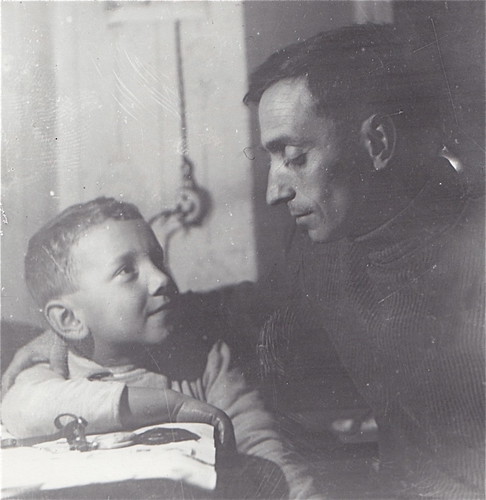
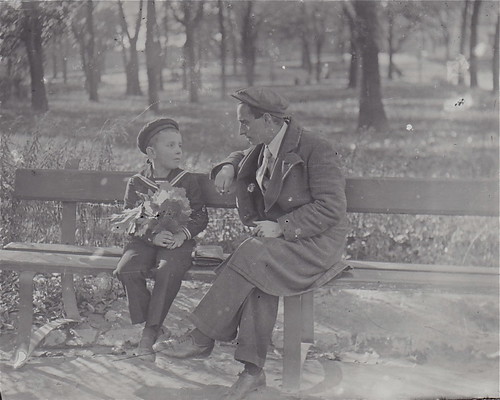
With my father - who looks Marta's age on the first picture and a little bit older on the second one, so this must be one of the last pre-war years, 1939 or 1940, but there's no way of knowing for sure, I guess:
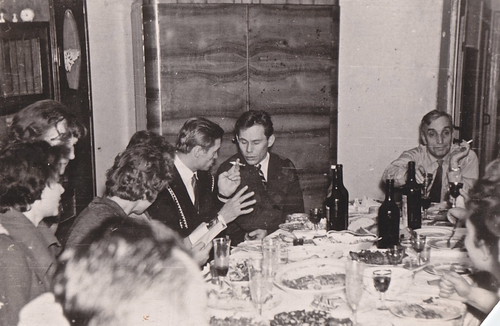
At some party at our place in Kyiv, with my father's friends - gymnasts Yuri Titov, Boris Shakhlin and Larisa Latynina - Olympic and world champions (only these three are identified on the back of this photo in my mother's handwriting):
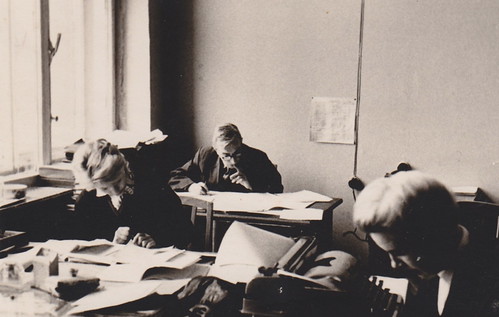
At work:
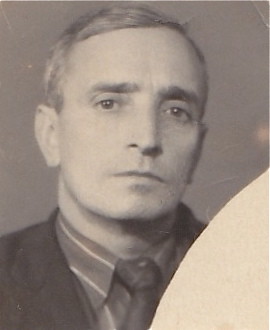
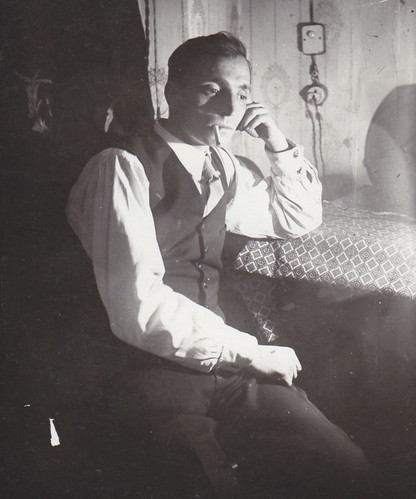
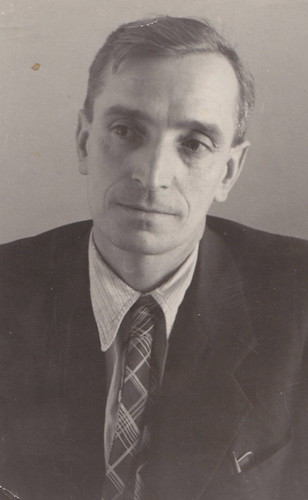
And some miscellaneous photos:
Suddenly, I was craving to look at all the old photos and papers stored back home in Kyiv, a messy and neglected collection, some of it packed into an ancient suitcase that I keep in my room, the rest hiding somewhere in the dark and dusty mazes of the so-called entresol, a space I've never really explored.
Home is where all this stuff is. A family history that's too sketchy and disorganized, that won't reveal itself unless someone talks about it. And my father's no longer around to talk about his part of this history. My history, too - but most of it out of reach now.
In Kyiv, I keep promising myself to buy a scanner next time I'm there, then sit down and go through as much of this paper and photo stuff as possible. But I never do this somehow. Part of me, I guess, is scared of attempting to connect with the family's past: what if I fail to connect - or, what if I find something I don't want to find there?
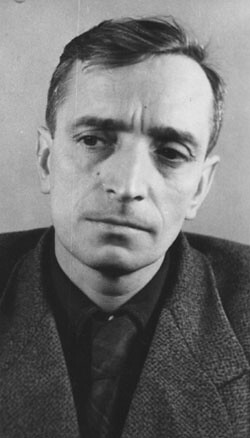
Here in Moscow, I only have a few photos of my father's father, and a few of my mother as a little girl. And I've a scanner here. So, to alleviate this unusual homesickness, I went ahead and scanned those few photos of Sergei Andreevich Khokhlov that I keep in the little pocket of my Dear Diary.
I don't know as much as I'd like to know about my grandfather. He was a very good man, everyone used to say. He died in 1969, unexpectedly, due to a surgery gone bad, at the age of 61. My father missed him very much, but he rarely talked about him - or maybe I just didn't listen well enough. I love to look at the photos of him: I find him very handsome. He had some Greek roots, according to my father (I wrote more about it here). He had nothing to do with tennis and was pretty upset when my father quit his studies at the Construction Engineering Institute after one year and switched to sports. For a while, he was furious, actually. He worked as a quantity surveyor (I had to look up the translation of the boring Russian term "сметчик": it sounds as boring in English). He was said to be the best quantity surveyor in Ukraine at some point, whatever that means. I had spent some time looking at his work-related papers - and also at his insanely detailed calculations for repairs in our two-room apartment (hilarious stuff, somehow) - and even though I don't understand anything about the field he worked in, I do understand that he was a very stubborn and meticulous person. And very independent. I find it moving. And I'm proud of him. And I'll try to write more about all this later. For now, here are some of his photos.
With my father - who looks Marta's age on the first picture and a little bit older on the second one, so this must be one of the last pre-war years, 1939 or 1940, but there's no way of knowing for sure, I guess:
At some party at our place in Kyiv, with my father's friends - gymnasts Yuri Titov, Boris Shakhlin and Larisa Latynina - Olympic and world champions (only these three are identified on the back of this photo in my mother's handwriting):
At work:
And some miscellaneous photos:
Subscribe to:
Posts (Atom)