I watched Tony Scott's "Man on Fire" in the middle of the night, Friday to Saturday night (don't ask me why - there're too many answers but none makes enough sense). In Russian, the film is called "Wrath" ("Gnev"), and though I wouldn't say that the Russian word necessarily implies vengeance, the English one does, and this is what the film is about. (Warning: spoilers ahead.)
It was horrible watching it - but I enjoyed it, in a masochistic way.
A relative fiction about one little, non-Mexican girl kidnapped somewhere in Mexico - and a vivid memory of a non-fictional kidnapping of several hundred non-Russian kids somewhere in Russia. The film is based on a true story, so it's only partly fiction - and a memory of something seen on TV isn't the actual experience, so, to most of us, Beslan is only partly non-fiction. Denzel Washington's revenge - the rescue of the girl - and his death at the end. An attempt to rescue the real kids - a total mess - and the real, irreversable death of too many of these real kids, and many of the adults. Bruce Willis in "Die Hard I" on an all-Russian, state-funded TV channel just several hours after the awful finale - Bruce Willis saving everyone - just like they all had been expecting him to do on Sept. 11 three years ago. Him or someone like him. Waiting for Putin to make some kind of a statement - thinking, with no real hope: what if he resigns?
I still can't believe they were showing "Die Hard" that night. "Man on Fire" would've been as inappropriate. Taking revenge instead of waiting for a hero. But revenge in real life never goes as smoothly as it does in Hollywood. It's never as beautiful and satisfying. Denzel Washington thought the girl was dead, this was his motivation for revenge - but she turned out to be alive. It's not like this in real life - those Beslan kids are dead, and their parents know it. Denzel Washington had the skills and the movie luck to hunt down and kick the shit out of the bad guys, causing no collateral damage. And just imagine what might happen after Oct. 13, when the 40-day mourning period ends in Beslan.
And still, on that night, I would've rather watched Denzel Washington's rage than Bruce Willis' heroics. Or none of it at all, not ever.
Saturday, September 25, 2004

Thursday, September 23, 2004
At the end of August, I sent two of my photos to the BBC News Online's photography competition, Photographer of the Year, and one of them was selected by their picture desk - and it's now posted in a picture gallery HERE.
The theme was Solitude, my photo is #6 of 12. I took it last year here in St. Pete, and the memory of this old woman is still breaking my heart.
There was a vote a few nights ago to select two winners in this category, and my picture didn't make it - but I'm so terribly happy about having been selected at all!!!!!!!!!
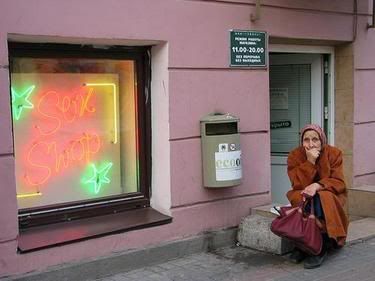
The theme was Solitude, my photo is #6 of 12. I took it last year here in St. Pete, and the memory of this old woman is still breaking my heart.
There was a vote a few nights ago to select two winners in this category, and my picture didn't make it - but I'm so terribly happy about having been selected at all!!!!!!!!!
AFTER BESLAN: NOTES ON THE COVERAGE (6)
The Valdai Discussion Club's website now has a compilation of articles published as the result of the Sept. 6 meeting with Putin. These so far include Susan B. Glasser's piece in The Washington Post; two of Jonathan Steele's Guardian stories that I have mentioned in the previous entries here; Fiona Hill's misleading op-ed in The New York Times that I've also examined a few days ago; two pieces by Mary Dejevsky of The Independent - one focusing on Putin's views on the situation in Chechnya, another providing a general overview of the meeting; a translation of Yevgenia M. Albats' exposé published in the Russian-language Yezhenedelny Zhurnal; and two analytical pieces by Simon Saradzhyan from The Moscow Times.
I've been planning to write about Yevgenia Albats text, but since it meant I'd have to translate extensively, I kept postponing it, out of laziness. I'm really glad that the hard part, the translation, has been done by someone else, Scott Stephens. I'm sure his translation is of a much higher quality than mine would have been - and I'm grateful to him.
I also feel that the Valdai Discussion Club folks deserve lots of credit for having re-published Albats' piece on their site; this is very courageous of them - because her piece, titled "The Kremlin Actively Recruits Western Experts to Improve Russia's Image," is very very critical of this whole endeavor and of the people who chose to participate in it.
Albats, a highly esteemed Russian journalist and member of the Center for Public Integrity's International Consortium of Investigative Journalists, tackles an issue that none of those who attended the conference and the meeting with Putin have so far chosen to focus much on: the money issue.
Comments provided to Albats by Mary Dejevsky of The Independent are quite telling, too:
However, there was indeed a non-free way to get access to Putin and other high-ranking Russian officials, according to Albats:
Obviously, Albats did not attend the conference and the meeting with Putin; allowing her in might have proved as detrimental to Russia's image as inviting Anna Politkovskaya, an outspoken Russian journalist who, allegedly, was poisoned on her way to Beslan, and thus prevented from covering the tragedy. According to Dejevsky, though, the real reason for leaving many of the local journalists out had to do with - ironically - money:
After I read Albats' piece, I was very curious about Dejevsky's post-Sept. 6 reports. But here the money issue struck again: I was too late to catch her stories while they were still available for free reading online. I looked for them on The Independent site, about a week ago, and the cheapest option for me was to pay "£1 for 24 hours' access to this article" - but I don't have a credit card and, even if I did, it'd still be such a waste, for why on earth would I need 24 hours to read a newspaper story? (The Valdai Discussion Club site has reprinted Dejevsky's stories not from The Independent but from The Belfast Telegraph - and this paper's options are significantly cheaper: they are asking just "50p for 24 hours' access to this article.")
In any case, I'm grateful to the Valdai Discussion Club people for giving me a chance to read two of Dejevsky's stories free of charge. One important thing that I've found out is that Putin didn't say he was prepared to violate the Russian Constitution in order to grant "maximum autonomy" to Chechnya, as Fiona Hill of the Brookings Institution wanted everyone to believe.
Here's what Dejevsky wrote on the issue in her first piece (Sept. 7):
While I find this oil revenue initiative interesting and will definitely look for more information on it, I still don't understand how all this endless talk about parliamentary election in Chechnya could be considered "an unexpected change of tone." And does Putin only "seem" to "extend an olive branch" - and if yes, how could it possibly be considered "a clear indication that he was open to the holding of parliamentary elections in Chechnya"? (Though I have to admit that, no matter how subjective Dejevsky's conclusions are, they are almost timid compared to the assertions Fiona Hill has made in her New York Times op-ed.)
In her Sept. 8 piece - "Evening of Surprises With a Hospitable President" - Dejevsky writes in great detail about the idyllic atmosphere of Putin's Novo-Ogaryovo residence and his great personal charm. All of this is, of course, sickeningly irrelevant to what had happened in Beslan just five days earlier. Actually, it's so sickening that I won't quote any of it here - I've provided the link to this piece at the beginning of this entry.
As for the confirmation of Fiona Hill's "maximum autonomy" comment - I haven't found it here, either. As in other sources, all Putin is quoted saying is this:
The Independent ran another post-Sept. 6 piece, which hasn't yet been posted on the Valdai Discussion Club site but is still somehow available free of charge: "Eyeball to Eyeball With Vladimir Putin" by John Kampfner, political editor of the New Statesman. In it, Kampfner treats Putin the way all presidents deserve to be treated: as politicians. This is the attitude that won't make Kampfner blush in the future:
This all sounds good. It's funny, though that the very next thing Kampfner chooses to allude to is, possibly, Yevgenia Albats' piece:
This is a good point, gracefully delivered, and, moreover, it doesn't contradict what Albats wrote about Mary Dejevsky: "...I cannot help mentioning that in contrast to Mary Dejevsky the reporter, Mary Dejevsky the columnist does not at all hide her sympathy for Russia's current leadership."
Kampfner's conclusions appear quite solid at first:
Kampfner is not "shouting from the rooftops" - but, unfortunately, he seems to be viewing the situation in Russia from as high up as a rooftop. If Beslan, and the Nord-Ost theater siege, and the numerous deadly explosions haven't been convincing enough, what else has to happen that would force Putin to reconsider some of his policies? On the other hand, there's a very sobering element in Kampfner's argument: if Russia is more dangerous to itself than it is to the West (which it sure is), then why does the West have to bother too much about getting involved? Even if we take the scary "domino effect" factor into account, isn't it more reasonable for the Russian citizens (including the Chechens and their neighbors) to try to get more involved first?
The Valdai Discussion Club's website now has a compilation of articles published as the result of the Sept. 6 meeting with Putin. These so far include Susan B. Glasser's piece in The Washington Post; two of Jonathan Steele's Guardian stories that I have mentioned in the previous entries here; Fiona Hill's misleading op-ed in The New York Times that I've also examined a few days ago; two pieces by Mary Dejevsky of The Independent - one focusing on Putin's views on the situation in Chechnya, another providing a general overview of the meeting; a translation of Yevgenia M. Albats' exposé published in the Russian-language Yezhenedelny Zhurnal; and two analytical pieces by Simon Saradzhyan from The Moscow Times.
I've been planning to write about Yevgenia Albats text, but since it meant I'd have to translate extensively, I kept postponing it, out of laziness. I'm really glad that the hard part, the translation, has been done by someone else, Scott Stephens. I'm sure his translation is of a much higher quality than mine would have been - and I'm grateful to him.
I also feel that the Valdai Discussion Club folks deserve lots of credit for having re-published Albats' piece on their site; this is very courageous of them - because her piece, titled "The Kremlin Actively Recruits Western Experts to Improve Russia's Image," is very very critical of this whole endeavor and of the people who chose to participate in it.
Albats, a highly esteemed Russian journalist and member of the Center for Public Integrity's International Consortium of Investigative Journalists, tackles an issue that none of those who attended the conference and the meeting with Putin have so far chosen to focus much on: the money issue.
Money was not spared on improving Russia's image abroad.
"They paid for roundtrip business-class airfare, though we could only take Aeroflot. If I had wanted to take my wife they would have paid for her, too," said David Johnson of the Center for Defense Information, a bit perplexed by the Russians' generosity. Johnson puts together a summary of news and views about Russia from publications worldwide, sends it out daily by email to about 5,000 subscribers and also places the information on his Web site. Journalists and political scientists consider it an honor to be featured in his summaries: Johnson's reputation is impeccable.
Thus, the operation aimed at influencing Western public opinion about Russia was made according to a well-established Russian public relations rule: he who pays the piper calls the tune. According to a former deputy who spoke on condition of anonymity, there is a little known line item in the federal budget that provides for financing events that enhance Russia's image.
In total, 42 guests were invited to the conference. Airfare was paid for; accommodations were provided at the Metropol, where the cheapest room costs $300 a night. All other expenses, including travel to and accommodations in Veliky Novgorod, were covered by RIA Novosti; in other words, the state picked up the tab.
Several journalists were also in attendance. I was sure that they had covered their expenses themselves: the ethics codes of many Western publications specifically bar journalists from allowing information sources to even pay for lunch, let alone a $2,500 first-class airline ticket. As it turns out, I was wrong.
"It isn't corruption," Jonathan Steele said, responding to my question about who covered his costs at the conference. [...]
Steele said that corruption happens when substantial royalties are paid, but that covering journalists' expenses is quite common among English newspapers. "Sometimes we indicate at the end of an article that expenses associated with its preparation were paid for [by someone besides the paper]," he said.
None of Steele's reports from Moscow, however, refers to the Russian government covering his expenses. True, he mentions in one report that the Russian president held a meeting with Western scholars and journalists who were attending a "special conference." But he does not disclose the fact that the aim of the conference was to enhance Russia's image abroad.
Comments provided to Albats by Mary Dejevsky of The Independent are quite telling, too:
Mary Dejevsky of the Independent, a British daily, had her own reasons for accepting the conference organizers' invitation and payment of her expenses. In a telephone interview, she said her paper weighs the importance of gaining access to representatives of foreign governments, and depending on that, such an invitation is accepted or rejected.
She said that if she had decided not to attend the conference, she would not have been able to tell her readers about this meeting with President Putin. [...]
"But what kept your paper from covering the expenses associated with getting such important information for your readers," I asked. Dejevsky said that while some organizations such as the BBC operated that way, her paper had a different policy. If she had refused to accept the offer, she might not have obtained access to such high-ranking Russian officials, she said.
However, there was indeed a non-free way to get access to Putin and other high-ranking Russian officials, according to Albats:
American television journalist Eileen O'Connor, who for many years headed CNN's Moscow bureau, also attended the conference, also was present at the meetings with Putin and Ivanov, and also was offered to have her expenses taken care of by conference organizers. O'connor turned down the offer. She informed the organizers that she would pay for both her flight and hotel expenses. O'Connor had come to Russia not as a news correspondent, but president of the nonprofit International Center for Journalists.
Obviously, Albats did not attend the conference and the meeting with Putin; allowing her in might have proved as detrimental to Russia's image as inviting Anna Politkovskaya, an outspoken Russian journalist who, allegedly, was poisoned on her way to Beslan, and thus prevented from covering the tragedy. According to Dejevsky, though, the real reason for leaving many of the local journalists out had to do with - ironically - money:
Responding to another question, Dejevsky explained that the reason Russian journalists were not invited to attend the meetings with Putin and Ivanov was due to the fact that Russian politicians "trust western reports more than they do the Russian press." She told me that the Russian press was extremely corrupt, was always writing stories for money, and that such practices could not be found anywhere among Western newspapers.
After I read Albats' piece, I was very curious about Dejevsky's post-Sept. 6 reports. But here the money issue struck again: I was too late to catch her stories while they were still available for free reading online. I looked for them on The Independent site, about a week ago, and the cheapest option for me was to pay "£1 for 24 hours' access to this article" - but I don't have a credit card and, even if I did, it'd still be such a waste, for why on earth would I need 24 hours to read a newspaper story? (The Valdai Discussion Club site has reprinted Dejevsky's stories not from The Independent but from The Belfast Telegraph - and this paper's options are significantly cheaper: they are asking just "50p for 24 hours' access to this article.")
In any case, I'm grateful to the Valdai Discussion Club people for giving me a chance to read two of Dejevsky's stories free of charge. One important thing that I've found out is that Putin didn't say he was prepared to violate the Russian Constitution in order to grant "maximum autonomy" to Chechnya, as Fiona Hill of the Brookings Institution wanted everyone to believe.
Here's what Dejevsky wrote on the issue in her first piece (Sept. 7):
In an unexpected change of tone, however, Vladimir Putin also held out the prospect of a more conciliatory line towards Chechnya, praising Chechen traditions and suggesting there was a possibility of broad-based parliamentary elections there. [...]
Seeming to extend an olive branch to a much broader swath of Chechen opinion than hitherto, Mr Putin said: "We will continue our dialogue with civil society. This will include holding parliamentary elections, trying to get as many people as possible involved, with as many views and policies as possible.' One of the big criticisms of Russia's policy in Chechnya is that it has held presidential elections from which the more popular opposition figures have been excluded, but delayed parliamentary elections.
Mr Putin gave a clear indication that he was open to the holding of parliamentary elections in Chechnya - although he did not give a date - in the hope of drawing many more people into the political process. He also said that the intention was to "strengthen law enforcement by staffing the police and other bodies in Chechnya with Chechens'.
The two moves together would amount to the continuation, even acceleration, of the policy of "Chechenisation', which some believed would be reversed after the spate of recent attacks in Russia: the downing of two planes, a bomb near a Moscow underground station, and, last week, the siege of School Number One in Beslan that cost more than 300 lives. [...]
In a little-noticed move two weeks before the attacks, the Russian government had decreed that Chechnya should be able to keep revenue from its oil, rather than remit the proceeds to Russia as currently happens. This was a major change in policy and one that irritated other regions that do not enjoy a similar right.
Mr Putin insisted, however, that Russia would retain troops in Chechnya. Their withdrawal is one of the separatists' main objectives. Russia had as much right to keep troops in the region as the US has to station its troops "in California or Texas', he said.
While I find this oil revenue initiative interesting and will definitely look for more information on it, I still don't understand how all this endless talk about parliamentary election in Chechnya could be considered "an unexpected change of tone." And does Putin only "seem" to "extend an olive branch" - and if yes, how could it possibly be considered "a clear indication that he was open to the holding of parliamentary elections in Chechnya"? (Though I have to admit that, no matter how subjective Dejevsky's conclusions are, they are almost timid compared to the assertions Fiona Hill has made in her New York Times op-ed.)
In her Sept. 8 piece - "Evening of Surprises With a Hospitable President" - Dejevsky writes in great detail about the idyllic atmosphere of Putin's Novo-Ogaryovo residence and his great personal charm. All of this is, of course, sickeningly irrelevant to what had happened in Beslan just five days earlier. Actually, it's so sickening that I won't quote any of it here - I've provided the link to this piece at the beginning of this entry.
As for the confirmation of Fiona Hill's "maximum autonomy" comment - I haven't found it here, either. As in other sources, all Putin is quoted saying is this:
On inter-ethnic disputes and criticism of Russia's Chechnya policy he retorted: "No one can accuse us of not being flexible in our dealings with the Chechen people. In 1995, we granted them de facto autonomy, but what happened was complete chaos, unbelievable violence. [...]"
The Independent ran another post-Sept. 6 piece, which hasn't yet been posted on the Valdai Discussion Club site but is still somehow available free of charge: "Eyeball to Eyeball With Vladimir Putin" by John Kampfner, political editor of the New Statesman. In it, Kampfner treats Putin the way all presidents deserve to be treated: as politicians. This is the attitude that won't make Kampfner blush in the future:
My extraordinary encounter with the Russian President on Monday night, as part of a group of mainly foreign academics, provided an insight, however fleeting, into the psychology of a president in whose name systematic human rights abuses have been committed.
The question that needs answering is not whether Putin is an evil man wilfully destroying Chechnya. It is not whether the depraved mass murder of children in Beslan was the result of his policies towards the Caucasus or simply a dreadful extension of global terror. The only useful question is, what do we do about it? [...]
So can anyone influence Putin, and, if so, how? The impression I came away with after listening to him for so long was ... possibly. The negatives were abundantly clear. He will not withdraw Russian troops. He will not negotiate with Chechen political leaders, whom he calls "child-killers". He is possessed of a Soviet-era conspiracy that certain forces in the West are helping the Chechens in order to destabilise Russia. He seems unapologetic in his persecution of journalists who seek to "undermine" the stability of the state.
Each statement was icily but eloquently delivered. [...]
This all sounds good. It's funny, though that the very next thing Kampfner chooses to allude to is, possibly, Yevgenia Albats' piece:
Some Russian journalists wrote afterwards that we Westerners had been picked out because we might be more gullible. Anyone who looks back at the reporting of Mary Dejevsky, Jonathan Steele or myself during Soviet times might think again. One does not have to enjoy being with Putin or agree with him to try to understand him.
This is a good point, gracefully delivered, and, moreover, it doesn't contradict what Albats wrote about Mary Dejevsky: "...I cannot help mentioning that in contrast to Mary Dejevsky the reporter, Mary Dejevsky the columnist does not at all hide her sympathy for Russia's current leadership."
Kampfner's conclusions appear quite solid at first:
Putin will eventually be forced to negotiate with the Chechens - all wars end that way. But it would be impossible for him to proceed soon, even if he wanted to, after such an attack. No world leader would do that. This is a man who is evidently not exercised by questions of democracy or human rights. What seems to matter to him personally, and the issue on which he has twice based his electoral appeal, is security. Putin has to be convinced that Russia's stability is jeopardised, not enhanced, by continuing the war. He has to be convinced that the West has no interest in seeing Russia weakened. He has to be shown that international mediation - most likely through the Organization for Security and Co-operation in Europe - will not be a humiliation. In a sense we may have to go back to the 1980s, to the era of detente and constructive engagement. Unlike that period, however, Russia is much more of a danger to itself and to its outlying regions than it is to us. We need to be wary but ready to become involved, rather than shouting from the rooftops.
Nothing will be gained from indulging Putin or denouncing him. The only possible chance we have in this desperate situation will come from steady, measured but incessant pressure.
Kampfner is not "shouting from the rooftops" - but, unfortunately, he seems to be viewing the situation in Russia from as high up as a rooftop. If Beslan, and the Nord-Ost theater siege, and the numerous deadly explosions haven't been convincing enough, what else has to happen that would force Putin to reconsider some of his policies? On the other hand, there's a very sobering element in Kampfner's argument: if Russia is more dangerous to itself than it is to the West (which it sure is), then why does the West have to bother too much about getting involved? Even if we take the scary "domino effect" factor into account, isn't it more reasonable for the Russian citizens (including the Chechens and their neighbors) to try to get more involved first?
Wednesday, September 22, 2004
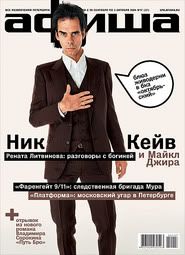
Nick Cave played here in St. Pete yesterday.
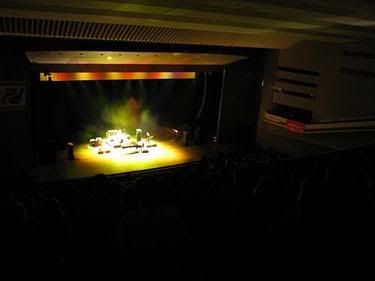
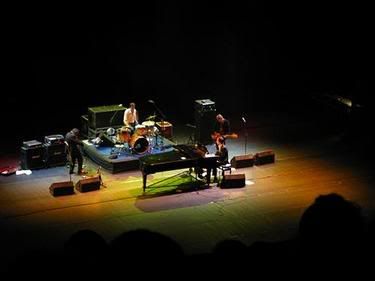
I'd have preferred to see him at a venue more intimate than the Oktyabrsky Concert Hall, a humongous, Soviet-ly gray and ugly place - but I'm not complaining. Mishah and I sat in the left corner of the last row of the balcony, almost on the roof - you can't get further than that - and again, I'm not complaining. I'm very happy I was there yesterday.
He played one of my favorite songs, the one that was originally recorded with PJ Harvey - "Henry Lee." There's always something in this song that I don't understand. Eight years ago, you should've seen me, a totally drunk 22-year-old, chasing a few Americans at an Easter party in Kyiv, trying to get them to explain a line or two that I couldn't quite make out. These Americans were, at the time, almost done drafting the Ukrainian constitution, no less. Now, both the lyrics and the constitution are available online. And yesterday, Nick Cave strayed from the original "Henry Lee" and shouted out something that began with "AND YOU RUSSIAN FUCKERS" - and I couldn't make out the rest of it. I suspect it was something about Chechnya - or maybe not. I hope eventually I'll find someone who heard it better than I did. (P.S. - 09/24 - Well, my friends who've also been to the concert told me it wasn't about Chechnya, not directly, at least - supposedly, he told the Russian fuckers to draw some kind of a lesson from Henry Lee's experience.)
Tuesday, September 21, 2004
Within hours after I posted the entry about the current mess in Iraq and in Chechnya, and the past mess in Lebanon, I ran into this 20-year-old story about a 1984 attack on the U.S. embassy in Beirut (The Guardian, "Suicide Bombers Kill 23 in Attack on Embassy," by David Hirst, Sept. 21, 1984).
A strange coincidence, but I'm a lot more amazed at how familiar this 20-year-old account is:
The impression that I was reading something written today - some kind of a template, perhaps, in which one only needs to substitute the names and the figures - didn't leave me until the very last paragraph: it was then that I realized I still hadn't stumbled on the mention of al-Qaeda or the ubiquitous shorthand for all that's evil, "international terrorism." Instead, there was this:
I decided to go back to Thomas Friedman's book and see if there was anything on David Hirst in it, the journalist who wrote this 20-year-old story. I was happy to find a rather amusing episode featuring him - I was happy because I feared he might have been killed at some point in his career, covering the war in Lebanon. I later checked Hirst's name on the web and found he was still out there, commenting extensively on the current situation in Iraq and the rest of the Middle East.
Honestly, I don't have enough zeal in me to study his current work at all - after reading this 20-year-old Beirut piece, all this fighting, in the Middle East or elsewhere, seems neverending, unstoppable, pointless and, to use a pun, done to death. There probably exist the good guys and the bad guys - only twenty years later the difference between them blurs almost completely, and the only thing that continues to shock is how many lives have been wasted in vain.
So here's the amusing episode from Thomas Friedman's "From Beirut to Jerusalem":
A strange coincidence, but I'm a lot more amazed at how familiar this 20-year-old account is:
A suicide car-bomber struck at the US embassy in Beirut yesterday for the second time in 18 months, killing at least 23 people, including two US diplomats, and wounding scores of others. The attack, claimed by the Islamic Jihad organisation as part of a campaign to drive every American from Lebanese soil, wrecked the annexe to the embassy, which recently opened in a quiet suburb of Christian East Beirut. [...]
One report said that the guards killed the driver but, if so, he nonetheless managed to cover the 30 yards or so between the barrier and the building [...]
The vehicle - a station wagon with Dutch diplomatic plates - exploded a yard or so from it, gouging a crater two yards deep and six wide. Although the building did not collapse - as happened last time - its ground floor was devastated and its upper floors badly damaged. Cars in the embassy compound were incinerated, wreckage and human remains scattered 200 yards, and windows were broken up to a kilometre away.
Most of the dead and wounded were Lebanese. [...]
In a telephone message to Agence France Presse a caller identifying himself as a spokesman for the Islamic Jihad said: 'In the name of God Almighty, the Islamic Jihad organisation announces that it is responsible for blowing up a car packed with explosives which was driven by one of our suicide commandos into a housing compound for the employees of the US embassy in Beirut .
'This operation comes to prove that we will carry out our promise not to allow a single American to remain on Lebanese soil. When we say Lebanese soil we mean every inch of Lebanese territory.
'We also warn our Lebanese brothers and citizens to stay away from US installations and gathering points, especially the embassy. We are the strongest.'
The Islamic Jihad, none of whose members has ever made a public appearance, is generally assumed to be Shi'ite fundamentalist sect, with Iranian and possible Syrian connections.
It has carried out several suicide missions. It claimed responsibility for killing 63 people, 17 of them Americans, in the explosion which destroyed the US embassy in its original, seafront location in West Beirut in April last year, and for the slaughter of 242 US Marines in their quarters next to Beirut airport in November. [...]
The impression that I was reading something written today - some kind of a template, perhaps, in which one only needs to substitute the names and the figures - didn't leave me until the very last paragraph: it was then that I realized I still hadn't stumbled on the mention of al-Qaeda or the ubiquitous shorthand for all that's evil, "international terrorism." Instead, there was this:
Yesterday's exploit illustrates again that there is no foolproof precaution against the ultimate self-sacrifice of the car-bomb.
I decided to go back to Thomas Friedman's book and see if there was anything on David Hirst in it, the journalist who wrote this 20-year-old story. I was happy to find a rather amusing episode featuring him - I was happy because I feared he might have been killed at some point in his career, covering the war in Lebanon. I later checked Hirst's name on the web and found he was still out there, commenting extensively on the current situation in Iraq and the rest of the Middle East.
Honestly, I don't have enough zeal in me to study his current work at all - after reading this 20-year-old Beirut piece, all this fighting, in the Middle East or elsewhere, seems neverending, unstoppable, pointless and, to use a pun, done to death. There probably exist the good guys and the bad guys - only twenty years later the difference between them blurs almost completely, and the only thing that continues to shock is how many lives have been wasted in vain.
So here's the amusing episode from Thomas Friedman's "From Beirut to Jerusalem":
Unfortunately, when reporters were left to probe to the limits of their own bravery, it meant inevitably that some went too far. During Israel's 1978 incursion into south Lebanon, up to the Litani River, David Hirst of The Manchester Guardian, Ned Temko of The Christian Science Monitor, and Doug Roberts of the Voice of America rode down from Beirut to observe the fighting. They were told by Palestinian guerrillas in Sidon that the PLO had just driven the Israeli army out of the nearby village of Hadatha. The three reporters decided to check out the story and found that actually the Israeli army had driven the Palestinians out of Hadatha and then vacated it. When Israeli gunners saw the three journalists drive in, they thought they were returning guerrillas and fired rounds at them on and off for eight hours. The next day the three "surrendered" to a unit of Israeli soldiers sitting on a nearby hilltop and were taken back to Israel for their own safety. As soon as they crossed the border, an Israel Radio reporter walked up to David Hirst and asked him how it felt to be rescued by the Israeli army.
"After they stopped shooting at us," answered David, "it was fine."
Monday, September 20, 2004
A story in The New York Times from three days ago - "For Some Beslan Families, Hope Itself Dies Agonizingly" (by SETH MYDANS, published Sept. 17, 2004) - too horrible, too painful to read:
This photo (by James Hill for The New York Times) accompanies the story:
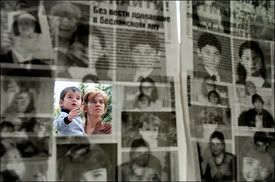
Caption: A mother and her child Thursday examined the pictures of victims of the Beslan school siege not yet identified or found. A picture was removed after one victim was found, though whether dead or alive is not known.
In today's story, "In Ethnic Tinderbox, Fear of Revenge for School Killings," Seth Mydans reports from an Ingush-populated town of Kartsa that "[b]oth here and in Beslan, people are talking about Oct. 13, the end of a 40-day mourning period, when the traditional moment comes to contemplate revenge."
This is not a nation whose government responds to the outcries of the bereaved, and they have been left on their own like the survivors and families in past disasters in Russia.
They plead with one official after another for help; they search hospitals in distant cities; they pick through bits and pieces of bone and flesh and teeth that have been set aside at the morgue like trays of party favors.
This photo (by James Hill for The New York Times) accompanies the story:
Caption: A mother and her child Thursday examined the pictures of victims of the Beslan school siege not yet identified or found. A picture was removed after one victim was found, though whether dead or alive is not known.
In today's story, "In Ethnic Tinderbox, Fear of Revenge for School Killings," Seth Mydans reports from an Ingush-populated town of Kartsa that "[b]oth here and in Beslan, people are talking about Oct. 13, the end of a 40-day mourning period, when the traditional moment comes to contemplate revenge."
AFTER BESLAN: NOTES ON THE COVERAGE (5)
Here's another passage from Jonathan Steele's Sept. 8 piece on the meeting with Putin two days earlier:
And here's one of those comments, which I don't find too enthralling, candid or surprising - though perhaps you have to be there in one room with Putin to get so charmed. Reading it from afar, I feel nothing but repulsion:
Putin didn't say Bush had actually managed to normalise the situation in Iraq - that could pass as candid, I guess, if it didn't require all that reading between the lines. And if what's happening in Iraq now - the hostages, explosions and all - is close to normal, then Chechnya must be like Sweden, close to perfect.
It all suddenly reminded me of one of my favorite passages from Thomas Friedman's book, "From Beirut to Jerusalem." The passage - stuck in the middle of the chapter called "The End of Something" - is about Nabil Tabbara, a Beiruti architect and professor of architecture:
This last quote never fails to make me cry and laugh at the same time.
In the first chapter (titled "Would You Like to Eat Now or Wait for the Cease-Fire?"), Friedman writes this about Beirut:
He quotes from Hobbes, too, in that chapter:
Some of it is probably an exaggeration when applied to contemporary Chechnya, but as a metaphor it's as good as any: comparing Chechnya's capital Grozny today to what Beirut was some twenty years ago is as evocative as calling Chechnya "a Hobbesian state" - something that David Remnick, editor of The New Yorker, promptly does in his most recent commentary ("Prisoners of the Caucasus," issue of Sept. 20, 2004; posted on the web on Sept. 13, 2004):
Although Remnick does refer in his piece to the Sept. 6 meeting with Putin, he, unlike a few others, doesn't appear charmed or misled in any way - maybe because he didn't attend the meeting and thus has managed to keep his common sense intact:
Here's another passage from Jonathan Steele's Sept. 8 piece on the meeting with Putin two days earlier:
If Vladimir Putin was feeling the pressure after possibly his worst week in office, it didn't show. During a rare and wide-ranging interview at his country house outside Moscow, the president enthralled a group of handpicked journalists and academics, giving candid comments that offered surprising insights.
And here's one of those comments, which I don't find too enthralling, candid or surprising - though perhaps you have to be there in one room with Putin to get so charmed. Reading it from afar, I feel nothing but repulsion:
Although Russia would not send troops or join in training the Iraqi army and police, [Putin] said: "We want to do everything to normalise things there. I think Bush has done a lot to normalise the situation. Given all the complexities, he's been able to achieve his aims. We will refrain from anything which might be met negatively by the Iraqi people."
Putin didn't say Bush had actually managed to normalise the situation in Iraq - that could pass as candid, I guess, if it didn't require all that reading between the lines. And if what's happening in Iraq now - the hostages, explosions and all - is close to normal, then Chechnya must be like Sweden, close to perfect.
It all suddenly reminded me of one of my favorite passages from Thomas Friedman's book, "From Beirut to Jerusalem." The passage - stuck in the middle of the chapter called "The End of Something" - is about Nabil Tabbara, a Beiruti architect and professor of architecture:
Like many of his generation, Tabbara [...] grew up being taken by his father on trips through the Beirut city center. The smell of the bazaar there, its spices and breads, its colors and sounds, and, most of all, the warmth of people mixing together, would always be part of his identity and his sense of Beirut as home. At the height of the civil war in 1976, it appeared that the graceful stone archways and marketplaces of the old city center were going to be destroyed forever. To keep a personal archive for himself of the Beirut he cherished, Tabbara took a leave from his architectural job and decided in the middle of the civil war that he would try to sketch and photograph what remained of the city center before it vanished.
"I didn't know what would be left of the old Beirut," Tabbara explained when I asked him what motivated this personal adventure, "and I always remembered the people of Warsaw who broke into their municipal archives after the Nazis invaded and hid all the plans and drawings of the Warsaw city center, which they used to rebuild it later."
Armed only with his Nikon camera, pencil, and sketchpads, Tabbara spent a month obtaining passes from all the different Muslim and Christian militias fighting along the Green Line, in order to freely enter the battle zone. Then he headed off to capture the last remnants of his youth.
"I would go down to the Phoenicia Hotel every morning, park my car, and then walk to the Green Line," he recalled. "At first the gunmen would say, 'Look at this fool sitting on the rubble sketching with the rockets and bullets going by.' They thought I was absolutely crazy. But after a while they really got into what I was doing. Some days they would lay down a barrage of machine-gun fire to cover me, so I could run across the dangerous street, or they would break into a building so I could get a particular view from the roof."
This last quote never fails to make me cry and laugh at the same time.
In the first chapter (titled "Would You Like to Eat Now or Wait for the Cease-Fire?"), Friedman writes this about Beirut:
I don't know if Beirut is a perfect Hobbesian state of nature, but it is probably the closest thing to it that exists in the world today.
He quotes from Hobbes, too, in that chapter:
In his classic work Leviathan, the seventeenth-century English political philosopher Thomas Hobbes described what he called "the state of nature" that would exist if government and society completely broke down and the law of the jungle reigned. In such a condition, wrote Hobbes, "where every man is enemy to every man ... there is no place for industry; because the fruit thereof is uncertain: and consequently no culture of the earth; no navigation, nor use of the commodities that may be imported by sea; no commodities building; no instruments of moving, and removingm such things as require much force; no knowledge of the face of the earth; no account of time; no arts; no letters; no society; and which is worst of all, continual fear, and danger of violent death; and the life of man, solitary, poor, nasty, brutish, and short."
Some of it is probably an exaggeration when applied to contemporary Chechnya, but as a metaphor it's as good as any: comparing Chechnya's capital Grozny today to what Beirut was some twenty years ago is as evocative as calling Chechnya "a Hobbesian state" - something that David Remnick, editor of The New Yorker, promptly does in his most recent commentary ("Prisoners of the Caucasus," issue of Sept. 20, 2004; posted on the web on Sept. 13, 2004):
Chechnya today is as close to a Hobbesian state as exists on earth. Grozny is a moonscape of gas fires, open sewers, and bombed-out buildings. There is almost no legitimate economy: at least seventy-five per cent of the Chechen workforce is unemployed. Criminal gangs dominate the social order. Politicians are assassinated; journalists and aid workers are abducted, even executed. The Russian Army troops who remain are corrupt, lawless, given to raping, kidnapping, and executing civilians. Whatever funds Moscow sends for rebuilding invariably end up stolen.
Although Remnick does refer in his piece to the Sept. 6 meeting with Putin, he, unlike a few others, doesn't appear charmed or misled in any way - maybe because he didn't attend the meeting and thus has managed to keep his common sense intact:
The note Putin struck most distinctly at the meeting with reporters and scholars was one of paranoia, fear that outside forces—the enemies he knew as a K.G.B. officer--were somehow undermining him. Those who mean to “tear off a big chunk of our country,” he said, are being backed by those who “think that Russia, as one of the greatest nuclear powers of the world, is still a threat, and this threat has to be eliminated.”
And so the Russian people, who live in dread of further violence, find themselves at the mercy of well-trained terrorists in the south and a paranoid President in the Kremlin who refuses the burdens of democratic accountability and the need to reshape a policy that is good for little but more bloodshed. [...]
Saturday, September 18, 2004
AFTER BESLAN: NOTES ON THE COVERAGE (4)
Before I move on to the more serious stuff, here's a little something that made me laugh while I was researching for the piece below:
- It looks like Democracy Now!, a daily radio and TV news program, employs a transcriber who knows very little about Chechnya (which is not too surprising - nor is it too bad in any way). He/she wrote this in the "rush transcript" of one of Amy Goodman's programs:
Of course, Mr. Peterson said "Ingush" - not "English"... Though, if you think about it, they do sound alike...
- On the same show, the following exchange took place between Amy Goodman and her next guest, Mary Dejevsky of The Independent, who had attended the meeting with Putin on Sept. 6 (the serious part of this entry is more or less about that meeting):
I love the ambiguity of it.
On to the more serious stuff...
***
Fiona Hill, a senior fellow at the Brookings Institution who was quoted in The Christian Science Monitor's Sept. 10 story saying Putin had "offered [Chechnya] 'maximum autonomy, even to the point of violating the Russian constitution,'" had her own op-ed piece published in The New York Times on the same day:
In the article, titled "Stop Blaming Putin and Start Helping Him," Ms. Hill stated that "[c]learly, he was sending a message that he needs the United States and Europe to pay careful attention as he responds to the massacre." She also repeated what she had told The Christian Science Monitor:
Shortly after Ms. Hill had made her observations public, Putin ordered major electoral changes, which were criticized by some and praised by others. These changes appear to be the opposite of what Ms. Hill claimed he had been "prepared" to do.
I've examined a few other accounts of Putin's Sept. 6 meeting with Western analysts and journalists, to see if any carried confirmation of Ms. Hill's optimistic claims. So far, I haven't succeeded.
David Johnson posted his notes on Johnson's Russia List (JRL, a superb resource on Russia, updated regularly by Mr. Johnson). He wrote that the meeting "was planned some time before the recent terror events in Russia and was a direct follow-on to the Valdai Discussion Club conference held September 3-4 in Veliky Novgorod. The conference was organized primarily by RIA Novosti and the [Russian] Council on Foreign and Defense Policy." Mr. Johnson's feeling is that "Putin was not thinking of the event as a press conference. It was more of a thoughtful discussion with long-time Russia-watchers, not a news-generating event." Hence, the sketchiness of his notes and this warning: "I would suggest that nothing here is worthy of further quotation. It's more useful in giving an impression of what was said than as an accurate record of details. ACTUALLY: DON'T QUOTE FROM THIS!"
I'll quote just one tiny thing: the following summary of Putin's words - "The Chechen constitution provides an enormous amount of autonomy." - refers to the constitution adopted as the result of a March 2003 referendum in Chechnya, not to anything intended in the near future.
The Guardian's Jonathan Steele also did not write anything that would confirm Ms. Hill's claim - neither in his partial notes from the meeting posted on JRL, nor in his Guardian pieces of Sept. 7 and Sept. 8.
In his Sept. 7 story, "Angry Putin Rejects Public Beslan Inquiry," Mr. Steele reported Putin's interest in finding a political solution to the situation in Chechnya:
But holding parliamentary elections in Chechnya is in complete accordance with the constitutions of both Chechnya and the Russian Federation. Also, there is nothing new/newsworthy in the fact that Putin says the election is going to take place - he has been reported to imply it in 2003, prior to the referendum ("'A constitution accepted by its people would become a basis for a political settlement in Chechnya, allowing them choose truly democratic authorities that would rely on popular trust,' Putin said, stressing that the republic would not be allowed to secede."), and he also mentioned it as recently as August 16, 2004 ("Russian President Vladimir Putin has said there is a need to hold parliamentary elections in Chechnya as soon as possible after the presidential elections.").
(On a different note, "angry Putin" calmed down a bit and, four days later, announced that a parliamentary inquiry would be conducted by the Federation Council, the upper house of the Parliament, whose members are not elected but appointed by the 89 federal subjects. But if you think there's much discussion here on where this inquiry might possibly lead and what horrible truths it would likely uncover - no, there's almost none, everyone's busy talking about Putin's undemocratic reorganization plans.)
Mr. Steele's Sept. 8 article, "Candid Putin Offers Praise and Blame," cast more doubt on the accuracy of Ms. Hill's remark: Putin, angry yesterday but candid today, "made it clear beyond doubt that he had not changed his policy on Chechnya after Beslan."
On JRL, in a note that precedes the transctipt of Putin's answers, Mr. Steele pointed out two things that made me suspect that neither Ms. Hill nor Putin were actually lying. Mr. Steele wrote that he "was the only person in the group who was taping the meeting" and, moreover, he "had only budgeted for a 90-minute meeting, and did not have enough tape for the entire encounter" (halfway through the transcript, this note was inserted: "Tape was changed over to the other side here, and a few sentences were lost"). Further, Mr. Steele wrote that the interpreter's "English was not perfect" - which is exactly what I was thinking a few days before: that they had a lousy translator!
So it is possible that Ms. Hill could have assumed that she heard something that hadn't actually been said - and I don't blame her for that. She didn't have a chance to correct her mistake because Mr. Steele was the only one with a tape recorder there - and since he ran out of tape, the part of Putin's speech that so confused Ms. Hill might have been missing.
But then she reported it all, and based much of her argument on the assumption that Putin was prepared to violate the Russian Constitution in order to give Chechnya broader autonomy - and The New York Times published Ms. Hill's op-ed piece without checking the facts first.
I wonder if they have posted a correction yet. Maybe they will. I hope someone will let me know if I miss it.
Before I move on to the more serious stuff, here's a little something that made me laugh while I was researching for the piece below:
- It looks like Democracy Now!, a daily radio and TV news program, employs a transcriber who knows very little about Chechnya (which is not too surprising - nor is it too bad in any way). He/she wrote this in the "rush transcript" of one of Amy Goodman's programs:
AMY GOODMAN: Has it been discovered yet exactly who the people are who did this?
SCOTT PETERSON [The Christian Science Monitor correspondent who wrote the piece I'm referring to at the very beginning of the serious part of this entry as well as in one of the previous entries; speaking on the phone from Beslan]: No. The authorities, even if they know, have not really been that specific yet. So, we're waiting to hear about that. It's not clear that we will ever know because Russia is not really known for its openness on this kind of issue. But certainly we have - I mean from the hostage survivors, I mean, they indicate that people - Chechnyan and English people took part. Hostages that I spoke to said that they didn't see any foreigners; but anyway, I think that the truth really remains to be seen.
Of course, Mr. Peterson said "Ingush" - not "English"... Though, if you think about it, they do sound alike...
- On the same show, the following exchange took place between Amy Goodman and her next guest, Mary Dejevsky of The Independent, who had attended the meeting with Putin on Sept. 6 (the serious part of this entry is more or less about that meeting):
AMY GOODMAN: We're talking with Mary Dejevsky who was with President Putin last night. Can you talk about the scene where he slammed on the table?
MARY DEJEVSKY: I'm sorry?
AMY GOODMAN: Can you talk about the scene where President Putin last night, where he slammed on the table, expressing anger?
MARY DEJEVSKY: Yes. I wouldn't say he slammed on it. He clenched his fists. He didn't pound them on the table. He was much more controlled than that [...]
I love the ambiguity of it.
On to the more serious stuff...
***
Fiona Hill, a senior fellow at the Brookings Institution who was quoted in The Christian Science Monitor's Sept. 10 story saying Putin had "offered [Chechnya] 'maximum autonomy, even to the point of violating the Russian constitution,'" had her own op-ed piece published in The New York Times on the same day:
On Monday, against the backdrop of the terrorist attack in Beslan, President Vladimir Putin of Russia held a remarkable four-hour discussion with a small group of American and Western European journalists and analysts at his official residence at Novo-Ogaryovo, outside Moscow. The meeting had been scheduled as part of a two-day conference on Russian-Western relations, but given the unfolding horrors at School No. 1, we were certain it would be canceled. Instead, President Putin turned it into a very personal exercise in public diplomacy.
In the article, titled "Stop Blaming Putin and Start Helping Him," Ms. Hill stated that "[c]learly, he was sending a message that he needs the United States and Europe to pay careful attention as he responds to the massacre." She also repeated what she had told The Christian Science Monitor:
President Putin told us that he was prepared to offer a great deal of autonomy to Chechnya, even to the point of "violating the Russian Constitution." This is something that he has resisted for some time, despite heavy pressure from some of his advisers and international opinion.
Shortly after Ms. Hill had made her observations public, Putin ordered major electoral changes, which were criticized by some and praised by others. These changes appear to be the opposite of what Ms. Hill claimed he had been "prepared" to do.
I've examined a few other accounts of Putin's Sept. 6 meeting with Western analysts and journalists, to see if any carried confirmation of Ms. Hill's optimistic claims. So far, I haven't succeeded.
David Johnson posted his notes on Johnson's Russia List (JRL, a superb resource on Russia, updated regularly by Mr. Johnson). He wrote that the meeting "was planned some time before the recent terror events in Russia and was a direct follow-on to the Valdai Discussion Club conference held September 3-4 in Veliky Novgorod. The conference was organized primarily by RIA Novosti and the [Russian] Council on Foreign and Defense Policy." Mr. Johnson's feeling is that "Putin was not thinking of the event as a press conference. It was more of a thoughtful discussion with long-time Russia-watchers, not a news-generating event." Hence, the sketchiness of his notes and this warning: "I would suggest that nothing here is worthy of further quotation. It's more useful in giving an impression of what was said than as an accurate record of details. ACTUALLY: DON'T QUOTE FROM THIS!"
I'll quote just one tiny thing: the following summary of Putin's words - "The Chechen constitution provides an enormous amount of autonomy." - refers to the constitution adopted as the result of a March 2003 referendum in Chechnya, not to anything intended in the near future.
The Guardian's Jonathan Steele also did not write anything that would confirm Ms. Hill's claim - neither in his partial notes from the meeting posted on JRL, nor in his Guardian pieces of Sept. 7 and Sept. 8.
In his Sept. 7 story, "Angry Putin Rejects Public Beslan Inquiry," Mr. Steele reported Putin's interest in finding a political solution to the situation in Chechnya:
[Russia is] going to hold elections to a Chechen parliament there shortly "and we will try to attract as many people as possible with different views to take part".
"We will strengthen law enforcement by staffing the police with Chechens, and gradually withdraw our troops to barracks, and leave as small a contingent as we feel necessary, just like the US does in California and Texas," [Putin] said.
He could not agree that a war was still going on there five years after he first sent in troops. "It is a smouldering conflict. There have been attacks but not like the big operations of 1999," he said.
But holding parliamentary elections in Chechnya is in complete accordance with the constitutions of both Chechnya and the Russian Federation. Also, there is nothing new/newsworthy in the fact that Putin says the election is going to take place - he has been reported to imply it in 2003, prior to the referendum ("'A constitution accepted by its people would become a basis for a political settlement in Chechnya, allowing them choose truly democratic authorities that would rely on popular trust,' Putin said, stressing that the republic would not be allowed to secede."), and he also mentioned it as recently as August 16, 2004 ("Russian President Vladimir Putin has said there is a need to hold parliamentary elections in Chechnya as soon as possible after the presidential elections.").
(On a different note, "angry Putin" calmed down a bit and, four days later, announced that a parliamentary inquiry would be conducted by the Federation Council, the upper house of the Parliament, whose members are not elected but appointed by the 89 federal subjects. But if you think there's much discussion here on where this inquiry might possibly lead and what horrible truths it would likely uncover - no, there's almost none, everyone's busy talking about Putin's undemocratic reorganization plans.)
Mr. Steele's Sept. 8 article, "Candid Putin Offers Praise and Blame," cast more doubt on the accuracy of Ms. Hill's remark: Putin, angry yesterday but candid today, "made it clear beyond doubt that he had not changed his policy on Chechnya after Beslan."
On JRL, in a note that precedes the transctipt of Putin's answers, Mr. Steele pointed out two things that made me suspect that neither Ms. Hill nor Putin were actually lying. Mr. Steele wrote that he "was the only person in the group who was taping the meeting" and, moreover, he "had only budgeted for a 90-minute meeting, and did not have enough tape for the entire encounter" (halfway through the transcript, this note was inserted: "Tape was changed over to the other side here, and a few sentences were lost"). Further, Mr. Steele wrote that the interpreter's "English was not perfect" - which is exactly what I was thinking a few days before: that they had a lousy translator!
So it is possible that Ms. Hill could have assumed that she heard something that hadn't actually been said - and I don't blame her for that. She didn't have a chance to correct her mistake because Mr. Steele was the only one with a tape recorder there - and since he ran out of tape, the part of Putin's speech that so confused Ms. Hill might have been missing.
But then she reported it all, and based much of her argument on the assumption that Putin was prepared to violate the Russian Constitution in order to give Chechnya broader autonomy - and The New York Times published Ms. Hill's op-ed piece without checking the facts first.
I wonder if they have posted a correction yet. Maybe they will. I hope someone will let me know if I miss it.
Thursday, September 16, 2004
AFTER BESLAN: NOTES ON THE COVERAGE (3)
On Friday, Sept. 10, 2004, The Christian Science Monitor ran a story that wasn't just soft on President Putin and the FSB - it was groundlessly optimistic about the steps the Russian leadership would be likely to take after the tragedies of the past two weeks ("Russia Shapes Plan of Attack" by SCOTT PETERSON):
This forecast turned out to be naive, even silly: three days after this piece appeared, on Monday, Sept. 13, Putin ordered a drastic political overhaul, which, many say, is unconstitutional, would do little to prevent further terrorist attacks and would make this country resemble the Soviet Union more than ever before in the past decade or so. Even George W. Bush was urged to speak up: he urged Putin to "uphold the principles of democracy."
Allegedly, Putin spoke of granting "maximum autonomy" to Chechnya at the meeting, about which The Christian Science Monitor reported no details whatsoever, except for its impressive length, three and a half hours, and its date, Monday, Sept. 6. But a week later, Putin announced radical political measures aimed at limiting - not expanding - the autonomy of Russia's 89 regions, including Chechnya. Maybe he wasn't really lying to his audience - maybe they just had a lousy translator or something.
If nothing else, the experts have sure been paying close attention to Putin's appearance:
To some of them, he looked like a man deserving some sympathy:
As for the threat of Russia carrying out "preemptive strikes ... to liquidate terrorist bases in any region of the world" - the experts have more or less agreed this wasn't something to worry about too much:
The piece wraps up with another of Anatol Lieven's quotes - a sober yet shocking assessment, which, nevertheless, takes some value off the numerous statements made by the anti-Putin, pro-human rights groups and individuals:
On Friday, Sept. 10, 2004, The Christian Science Monitor ran a story that wasn't just soft on President Putin and the FSB - it was groundlessly optimistic about the steps the Russian leadership would be likely to take after the tragedies of the past two weeks ("Russia Shapes Plan of Attack" by SCOTT PETERSON):
President Vladimir Putin refuses to meet with top Chechen separatist leaders, whom he holds responsible for a wave of terror that includes two downed passenger jets, a suicide bomb in Moscow, and the hostage crisis. But analysts say that Mr. Putin may offer far broader autonomy to Chechnya, which adds up to "de facto independence," according to American experts who took part in a 3 1/2-hour meeting with the Russian leader.
This forecast turned out to be naive, even silly: three days after this piece appeared, on Monday, Sept. 13, Putin ordered a drastic political overhaul, which, many say, is unconstitutional, would do little to prevent further terrorist attacks and would make this country resemble the Soviet Union more than ever before in the past decade or so. Even George W. Bush was urged to speak up: he urged Putin to "uphold the principles of democracy."
Allegedly, Putin spoke of granting "maximum autonomy" to Chechnya at the meeting, about which The Christian Science Monitor reported no details whatsoever, except for its impressive length, three and a half hours, and its date, Monday, Sept. 6. But a week later, Putin announced radical political measures aimed at limiting - not expanding - the autonomy of Russia's 89 regions, including Chechnya. Maybe he wasn't really lying to his audience - maybe they just had a lousy translator or something.
"He's not going to deal with a group of fighters who carry out terror attacks ... He wants to annihilate the radicals," says Fiona Hill of the Brookings Institution in Washington, who met with Putin on Monday.
Putin offered "maximum autonomy, even to the point of violating the Russian constitution," says Ms. Hill. "Does he have something down in a blueprint? I don't know. But I would say give him the benefit of the doubt for now, and see what he does."
If nothing else, the experts have sure been paying close attention to Putin's appearance:
"Certainly the veins on his skull bulge when he talks about [autonomy]," says Cliff Kupchan of the Eurasia Foundation, who also attended the Putin meeting. "He spoke about expanding the dialogue and drawing in groups that have not been included before."
To some of them, he looked like a man deserving some sympathy:
Finding those groups will not be easy. "[Putin's] been thinking hard, and looks like an alarmed man who has his back up against the wall," says Hill. "He needs help on border security, on intelligence gathering because they just don't have the capacity anymore. This is the kind of job the FSB [formerly the KGB] used to do."
As for the threat of Russia carrying out "preemptive strikes ... to liquidate terrorist bases in any region of the world" - the experts have more or less agreed this wasn't something to worry about too much:
"You always get this wave of macho talk about how we're going to do this and do that, in order to show that the military is still worth it," says Anatol Lieven, author of "Chechnya: Tombstone of Russian Power,"at the Carnegie Endowment for International Peace in Washington. [...]
"They are saying that what's good for the goose is good for the gander: If you [in the US] can do it, we after such an attack can do it as well," says Mr. Lieven. "The military has obviously failed. [The Kremlin] is bankrupt, totally bankrupt of ideas." [...]
Boris Kagarlitsky, head of the Institute of Comparative Politics in Moscow, is blunter: "It is pure propaganda ... that will not make any strategic or military sense. It reminds one of a man who is in fact impotent, but wants to pretend he is still a Casanova."
The piece wraps up with another of Anatol Lieven's quotes - a sober yet shocking assessment, which, nevertheless, takes some value off the numerous statements made by the anti-Putin, pro-human rights groups and individuals:
"The Russians have not yet done everything that they could in terms of savagery," says Lieven. "All this talk of Russian abuses - most of [it is] true. But if you remember American strategy in Vietnam, or the French in Algeria, they cleared extensive areas of the countryside, put people behind barbed wire ... Anyone in those areas was by definition an enemy and shot on the spot."
"The Russians haven't done that yet," adds Lieven. "Another few attacks like this [and] the Russians could adopt much more ferocious measures."
Wednesday, September 15, 2004
My friend is writing about grieving the loss of her sister.
I've just read all of it, from the beginning to the very end.
When I was reading it, I felt it was all mine, to the tiniest detail.
When I finished reading, I realized that only the emotions were mine as well as my friend's - the memories and the experience were all hers.
Although my pain and my emotions are probably nowhere near as intense as hers, I still feel her loss is mine, too. And I feel like reading it all over again, just to live through those happy memories of being around her wonderful sister once more.
Grieving is so much about remembering all the wonderful moments.
I keep thinking about Beslan all the time - there is no place for politics in grieving. Politics may come in later, as a distraction. When there is no politics available, there is writing. And I don't know what else, how other people cope. Revenge is a distraction, too, but more often than not there is no one to take revenge on.
And when there is no grieving, there is politics.
Here are two passages from my friend's journal - but I really think nearly all of it is quoteworthy...
I've just read all of it, from the beginning to the very end.
When I was reading it, I felt it was all mine, to the tiniest detail.
When I finished reading, I realized that only the emotions were mine as well as my friend's - the memories and the experience were all hers.
Although my pain and my emotions are probably nowhere near as intense as hers, I still feel her loss is mine, too. And I feel like reading it all over again, just to live through those happy memories of being around her wonderful sister once more.
Grieving is so much about remembering all the wonderful moments.
I keep thinking about Beslan all the time - there is no place for politics in grieving. Politics may come in later, as a distraction. When there is no politics available, there is writing. And I don't know what else, how other people cope. Revenge is a distraction, too, but more often than not there is no one to take revenge on.
And when there is no grieving, there is politics.
Here are two passages from my friend's journal - but I really think nearly all of it is quoteworthy...
Tuesday, July 27, 2004
Lissa still asks for her mom. Andy still lays on his bed and cries for a few minutes before he gets up to play. Amy's son scribbles letters to Sis. "I miss Aunt ____," he says. "She can't come back from heaven, so I'll just write her a letter." They do what they need to do, then they move on with their day.
Small children express themselves naturally. Their joy, their anger, their excitement, their grief. Society has not yet told them there's an appropriate way to feel and a time limit on their emotional expressions.[...]
I have been to a therapist or two in my life for various reasons. They tell me it's good that I write it out. They say I'm healthy and don't need to see a doctor. Then they tell me it's been long enough, I shouldn't be writing about it or even thinking about it every day anymore. These same people write articles and learn from studies that state the grief process sometimes spans years. And yet they tell me one year is long enough. Don't talk about her anymore, they say. Don't give her another thought. Never mind she was your closest friend. Never mind your rock is gone. Forget about it. I know people who've grieved longer over the break-up of a relationship and it was perfectly acceptable. Expected, even, in some cases. But it's not acceptable for me to grieve the death of my sister beyond the one year mark.[...]
Monday, August 30, 2004
I often imagine myself in that car as the tires of the truck roll over the front seat. Sometimes I imagine sitting next to her. Sometimes I imagine I am her. I play it in fast forward and in slow motion, bones snapping, the smell of hot metal and blood in my nose.
Perhaps there was time for only one thought. Maybe it was realization of her coming death, concern for her children, or simply "oh fuck". Or maybe it was something absurd like "Good thing I put on clean underwear."
AFTER BESLAN: NOTES ON THE COVERAGE (2)
First, The New York Times ran a story under this headline: "Russian Rebels Had Precise Plan" (by C. J. CHIVERS and STEVEN LEE MYERS; published Sept. 6, 2004). Some people noted that it was almost like referring to the IRA guys as "British rebels."
Then, The New York Times ran this story: "Chechen Rebels Mainly Driven by Nationalism" (by C. J. CHIVERS and STEVEN LEE MYERS; published Sept. 12, 2004).
This is an interesting piece, with quite a variety of sources, ranging from the rather intangible "Russian and international officials and experts" and "three senior counterterrorism officials in Europe, who spoke on condition of anonymity because of diplomatic sensitivities" to the, allegedly, very real people like "Sergei N. Ignatchenko, chief spokesman for Russia's Federal Security Service," "Ilyas Akhmadov, a Chechen leader living in the United States," "Juan Zarate, an assistant secretary at the United States Treasury Department," "Dia Rashwan of Al Ahram Center for Political and Strategic Studies in Cairo" and a number of others. The piece also contains a reference to "an unclassified report provided by the F.S.B." and a quote from Osama bin Laden's 1997 interview on CNN.
Overall, the story and the quotes do not contradict the thesis of the lead - and yet, somehow, I felt that the reporters were being unusually kind to President Putin and the FSB.
Consider this sentence about the beginning of the second Chechen war in 1999:
It isn't merely superficial (which is okay for a piece that transcends the typical recounting of the timeline of the Chechen wars) - it's weird. Do bombs drive or walk around, destroying apartment buildings? Do bombs act on their own? Even Mr. Basayev doesn't.
When the apartment buildings were blown up in mid-September 1999, roughly a month after Yeltsin unearthed Putin, it didn't occur to me to question the official version at first: maybe the Chechens indeed were behind the explosions. But very soon I realized that way too many Muscovites were talking about the FSB's role in this horror - and some of these Muscovites weren't the biggest fans of the Chechens and other ethnic minorities. So I thought, How strange - isn't it easier to blame the ones you dislike than those who are supposed to be protecting you from the ones you dislike?
In 2002, The New York Times ran a piece based on an interview with Boris Berezovsky: "Russian Says Kremlin Faked 'Terror Attacks'" (by PATRICK E. TYLER; published Feb. 1, 2002). Here's part of it, which shows that there used to be a lot more to say about those stray bombs:
Mr. Patrushev, by the way, is still the head of the FSB. The list of the bad bad terror-related things that have happened during his five-year reign is impressive (via The Moscow News; unfortunately, I haven't found an English translation of the piece about Mr. Patrushev):
The FSB has a website (in Russian); closer to the bottom of their front page I found a note from 2003, which tells us that on Sept. 11, Felix Dzerzhinsky, the founder of what later became known as the KGB, the predecessor of the FSB, turned 126 years old. How nice.
Back to the stray bombs: on Sept. 9, 2004, the very same New York Times published an op-ed piece, "Give the Chechens a Land of Their Own," by Richard Pipes, an emeritus professor of history at Harvard and the author of "A Concise History of the Russian Revolution." In it, Pipes does mention the ambiguity of the 1999 explosions:
It's interesting that C. J. Chivers and Steven Lee Myers do not mention General Lebed in their article. Their take on the end of the first Chechen war is this:
This is factually true, of course, but is as incomplete as the stray bombs sentence. As I said above, the purpose of this article wasn't to reproduce for the millionth time the chronology of the Chechen wars, but still, certain points in this routine background part could have been more convincing. Here's the rest of the war account, parts of which read a little bit like a translated FSB statement:
It's strange to be reminded of General Lebed now, at the time when President Putin is scaring everyone speechless with his neo-Soviet rhetoric, most likely in order to take the focus off the Beslan tragedy and the Chechnya catastrophe. What would this country be like if Lebed survived that helicopter crash in April 2002? Here's his short bio from the BBC website:
And here's a quote that ends a 1996 New York Times story by Michael Specter on the surrender of Grozny, an amazing piece that shows the magnitude of the changes that have occurred in the past eight years, not just in Russia and in the world but in the New York Times as well: Specter's "How the Chechen Guerrillas Shocked Their Russian Foes" is incomparably bolder and much more informative than many of the recent pieces, including "Chechen Rebels Mainly Driven by Nationalism."
First, The New York Times ran a story under this headline: "Russian Rebels Had Precise Plan" (by C. J. CHIVERS and STEVEN LEE MYERS; published Sept. 6, 2004). Some people noted that it was almost like referring to the IRA guys as "British rebels."
Then, The New York Times ran this story: "Chechen Rebels Mainly Driven by Nationalism" (by C. J. CHIVERS and STEVEN LEE MYERS; published Sept. 12, 2004).
MOSCOW, Sept. 11 - Chechnya's separatists have received money, men, training and ideological inspiration from international Islamic organizations, but they remain an indigenous and largely self-sustaining force motivated by nationalist more than Islamic goals, Russian and international officials and experts say.
This is an interesting piece, with quite a variety of sources, ranging from the rather intangible "Russian and international officials and experts" and "three senior counterterrorism officials in Europe, who spoke on condition of anonymity because of diplomatic sensitivities" to the, allegedly, very real people like "Sergei N. Ignatchenko, chief spokesman for Russia's Federal Security Service," "Ilyas Akhmadov, a Chechen leader living in the United States," "Juan Zarate, an assistant secretary at the United States Treasury Department," "Dia Rashwan of Al Ahram Center for Political and Strategic Studies in Cairo" and a number of others. The piece also contains a reference to "an unclassified report provided by the F.S.B." and a quote from Osama bin Laden's 1997 interview on CNN.
Overall, the story and the quotes do not contradict the thesis of the lead - and yet, somehow, I felt that the reporters were being unusually kind to President Putin and the FSB.
Consider this sentence about the beginning of the second Chechen war in 1999:
After Mr. Basayev led a raid into Dagestan and bombs destroyed three apartment buildings in Russia, Russian forces poured into Chechnya again.
It isn't merely superficial (which is okay for a piece that transcends the typical recounting of the timeline of the Chechen wars) - it's weird. Do bombs drive or walk around, destroying apartment buildings? Do bombs act on their own? Even Mr. Basayev doesn't.
When the apartment buildings were blown up in mid-September 1999, roughly a month after Yeltsin unearthed Putin, it didn't occur to me to question the official version at first: maybe the Chechens indeed were behind the explosions. But very soon I realized that way too many Muscovites were talking about the FSB's role in this horror - and some of these Muscovites weren't the biggest fans of the Chechens and other ethnic minorities. So I thought, How strange - isn't it easier to blame the ones you dislike than those who are supposed to be protecting you from the ones you dislike?
In 2002, The New York Times ran a piece based on an interview with Boris Berezovsky: "Russian Says Kremlin Faked 'Terror Attacks'" (by PATRICK E. TYLER; published Feb. 1, 2002). Here's part of it, which shows that there used to be a lot more to say about those stray bombs:
LONDON, Jan. 31 — Intensifying his battle with the Kremlin, the Russian oligarch Boris A. Berezovsky said today that he was just weeks away from laying out documentary evidence that Russia's security services were involved in apartment- house explosions in September 1999 that killed more than 300 people.
In an interview here, he said his investigation of the bombings, which were ascribed to separatists in Chechnya and touched off a full-scale invasion of that rebellious republic, was the reason Nikolai Patrushev, Russia's intelligence chief, accused him last week of providing financial support to Chechen "terrorists."
Mr. Berezovsky said his evidence "is no less than the evidence the United States had that Osama bin Laden was responsible for the World Trade Center attack."
He said the key to his case was the discovery in late September 1999 that Russia's security services had placed what appeared to be a large bomb in an apartment in Ryazan, 115 miles southeast of Moscow.
When residents discovered the bomb and called the police, the Federal Security Service, or F.S.B., issued a public apology and asserted that the "explosives" were actually bags of sugar tied together with wires and a detonator, a dummy used as part of a security exercise.
A number of Russian legislators called for an independent investigation of the bombings and the actions of the security service in Ryazan, but in March 2000 Parliament defeated a motion to open an inquiry. Vladimir V. Putin, a former head of the Federal Security Service, won the presidential election the same month. Mr. Patrushev succeeded him at the security service.
In the jaded politics of today's Russia, Mr. Berezovsky's claims have been treated with as much skepticism as the counterclaims of Mr. Patrushev and the security service. The fact that the charges emerged as Mr. Berezovsky was losing another battle to retain control of the independent TV6 television channel added to that skepticism.
Yet the unsolved explosions that brought terror to Russia and incited Russians against Chechens and other ethnic groups from the Caucasus stand as an enduring and troubling mystery of the Chechen conflict.
Though dozens of arrests were made in the bombings, no one has been convicted of direct complicity. Moreover, the bombings laid the groundwork for the furious military campaign against Chechnya and for the political rise of Mr. Putin, then the prime minister, whose relentless prosecution of the war garnered a surge of popular support that propelled him into the presidency.
Mr. Berezovsky said today that he had no evidence that Mr. Putin had personal knowledge of any involvement by security services in the apartment bombings, but he said Mr. Patrushev did. [...]
Mr. Patrushev, by the way, is still the head of the FSB. The list of the bad bad terror-related things that have happened during his five-year reign is impressive (via The Moscow News; unfortunately, I haven't found an English translation of the piece about Mr. Patrushev):
- Moscow Manezh explosion - 1 person killed
- Buinaksk apartment building explosion - 64
- Moscow apartment building explosions - 230
- Volgodonsk apartment building explosion - 18
- Moscow Pushkin Square explosion - 12
- Pyatigorsk train station and market explosions - 7
- Kaspiysk Victory Day explosion - 45
- Yessentuki, Minvody and Cherkessk explosions - 24
- Astrakhan and Vladikavkaz explosions - 19
- Moscow McDonald's explosion - 1
- Nord-Ost theater hostage crisis - 128
- Grozny government building truck explosion - 70
- Mozdok air base bus explosion - 18
- Moscow rock festival explosion - 16
- North Osetia police bus explosion - 3
- Mozdok hospital explosion - 50
- Yessentuki commuter train explosions - 48
- Moscow Hotel "National" explosion - 5
- Moscow subway train explosion - 39
- Grozny Victory Day explosion - 4
- twin plane crashes - 90
- Moscow subway station explosion - 11
- Beslan school hostage crisis - over 300
The FSB has a website (in Russian); closer to the bottom of their front page I found a note from 2003, which tells us that on Sept. 11, Felix Dzerzhinsky, the founder of what later became known as the KGB, the predecessor of the FSB, turned 126 years old. How nice.
Back to the stray bombs: on Sept. 9, 2004, the very same New York Times published an op-ed piece, "Give the Chechens a Land of Their Own," by Richard Pipes, an emeritus professor of history at Harvard and the author of "A Concise History of the Russian Revolution." In it, Pipes does mention the ambiguity of the 1999 explosions:
A clever arrangement secured by the Russian security chief, Gen. Alexander Lebed, in 1996 granted the Chechens de facto sovereignty while officially they remained Russian citizens. Peace ensued. It was broken by several terrorist attacks on Russian soil, which the authorities blamed on the Chechens (although many skeptics attributed them to Russian security agencies eager to create a pretext to bring Chechnya back into the fold). A second Chechen war began in 1999, of which there seems no end in sight.
It's interesting that C. J. Chivers and Steven Lee Myers do not mention General Lebed in their article. Their take on the end of the first Chechen war is this:
That war ended in 1996 after forces led by Shamil Basayev, the Chechen commander believed to have organized the siege in Beslan, recaptured Chechnya's capital, Grozny. The Russians withdrew, granting the republic de facto independence. Chechnya slipped into chaos and banditry.
This is factually true, of course, but is as incomplete as the stray bombs sentence. As I said above, the purpose of this article wasn't to reproduce for the millionth time the chronology of the Chechen wars, but still, certain points in this routine background part could have been more convincing. Here's the rest of the war account, parts of which read a little bit like a translated FSB statement:
At the time, foreign fighters expanded their influence, and Islamic charities began funneling money into Chechnya, according to the Federal Security Service, or F.S.B. The money was ostensibly for religious and aid purposes, but was diverted for weapons, uniforms and other equipment, as well as for salaries.
[...] Chechnya's period of independence, when the republic was lawless, appears to have been the peak of the transit of fighters, cash and ideology from abroad. It soon ended.
After Mr. Basayev led a raid into Dagestan and bombs destroyed three apartment buildings in Russia, Russian forces poured into Chechnya again. The Russians drove the separatists, with their Islamic fighters, into the mountains along the border and destroyed the training camps.
Russian troops, along with loyal Chechen fighters, now control almost all the republic, at least by day. The separatists, however, still carry out regular attacks.
It's strange to be reminded of General Lebed now, at the time when President Putin is scaring everyone speechless with his neo-Soviet rhetoric, most likely in order to take the focus off the Beslan tragedy and the Chechnya catastrophe. What would this country be like if Lebed survived that helicopter crash in April 2002? Here's his short bio from the BBC website:
Lebed, who came third in the Russian presidential election of 1996, was once considered a possible successor to President Boris Yeltsin.
But Lebed refused to stand again in the year 2000, saying he had work to finish in Siberia.
He was widely credited with ending Russia's 1994-96 campaign in Chechnya within a matter of months of being appointed security chief by President Yeltsin, but was ejected from office shortly afterwards.
Before that, he quelled a civil war in Moldova in the summer of 1992 as commander of Russian troops stationed there.
Lebed, who trained and served in Afghanistan from 1981-82, also won plaudits in 1991 during the coup attempt against then President Gorbachev, when he refused to deploy his troops on the coup leaders' side.
And here's a quote that ends a 1996 New York Times story by Michael Specter on the surrender of Grozny, an amazing piece that shows the magnitude of the changes that have occurred in the past eight years, not just in Russia and in the world but in the New York Times as well: Specter's "How the Chechen Guerrillas Shocked Their Russian Foes" is incomparably bolder and much more informative than many of the recent pieces, including "Chechen Rebels Mainly Driven by Nationalism."
"'Lebed is a Russian,' said Mussa Guysamo, a young fighter working in the brigade directly commanded by Mr. Basayev in the center of Grozny. 'But he is a fighter. And a fighter knows when he has lost.'"
Monday, September 13, 2004
Boy, there's so much stuff out there to distract one from the actual grieving.
And I don't just mean shows like Pimp My Ride on MTV or Globe Trekker on the Discovery Channel. I've never watched them before - but this weekend they proved extremely useful in helping me laugh without any second thoughts. Speaking of the TV, I was quite amazed to learn that one of the Russian channels (can't remember which one right now) was showing Lars von Trier's Dancer in the Dark late Friday night. I saw it in 2001, loved it - but if someone asked me to choose between watching it now and spending the night out in the street, I'd happily pick the latter. Then again, many of us here prefer drinking to watching TV on Friday nights anyway - and drinking is very therapeutic in times like these - so I'm sure only a few people faced the dilemma of whether to subject themselves to von Trier's intellectual torture or to stick to the normal drinking routine.
Other potential distractions include:
- pretending North Osetia is some tiny, God-forgotten country that has no relation whatsoever to Russia (one Russian friend finds this helpful; doesn't work for me - perhaps because I'm a Ukrainian and much of Russia, including North Osetia, has little, or way too much, to do with Ukraine, depending on how you look at it... no, this doesn't make sense... I guess it's more about how one's imagination works, how far one can stretch one's imagination in times of trouble);
- spending more time cooking wonderful things (as another friend of mine recommended; well, I need huge inspiration to be able to cook at all, and this weekend there wasn't much of it, but I'm not discarding this advice - I acquired a very pretty tea set yesterday, which makes us feel so much more at home, and that was a good start in that direction, I hope);
- making babies (this was the second recommendation of this dear friend of mine; I don't know - it's very difficult to think of having kids of your own when so many other people's kids have just been killed in such a horrible way; but then I'm reminded of the NYC baby boom in the wake of 9/11, and maybe there is some logic to it after all...);
- taking the brand new and somewhat controversial 48-hour train from Moscow to Sukhumi, Abkhazia, and writing about it (that's an option suggested by an editor friend; it was more of an assignment, actually, which I'm not able to take because of my foreigner status in this country; very upsetting because I love writing about trains).
Besides all this, there are papers to read, an incredible cacophony of political pronouncements, and I hope to write a little bit more about what I've managed to make out of it later tonight. But yes, reading has been very therapeutic - even though a prerequisite for such reading has been a note stored in the back of my mind: remember the images of the kids, remember the pain you've been through and remember the pain people in Beslan are still experiencing, and then, every now and then, place the stuff you're reading in the context of this pain and see if some of it is maybe capable of soothing some of this pain, of mending some of what's been ruined, of preventing something similar from happening again...
And I don't just mean shows like Pimp My Ride on MTV or Globe Trekker on the Discovery Channel. I've never watched them before - but this weekend they proved extremely useful in helping me laugh without any second thoughts. Speaking of the TV, I was quite amazed to learn that one of the Russian channels (can't remember which one right now) was showing Lars von Trier's Dancer in the Dark late Friday night. I saw it in 2001, loved it - but if someone asked me to choose between watching it now and spending the night out in the street, I'd happily pick the latter. Then again, many of us here prefer drinking to watching TV on Friday nights anyway - and drinking is very therapeutic in times like these - so I'm sure only a few people faced the dilemma of whether to subject themselves to von Trier's intellectual torture or to stick to the normal drinking routine.
Other potential distractions include:
- pretending North Osetia is some tiny, God-forgotten country that has no relation whatsoever to Russia (one Russian friend finds this helpful; doesn't work for me - perhaps because I'm a Ukrainian and much of Russia, including North Osetia, has little, or way too much, to do with Ukraine, depending on how you look at it... no, this doesn't make sense... I guess it's more about how one's imagination works, how far one can stretch one's imagination in times of trouble);
- spending more time cooking wonderful things (as another friend of mine recommended; well, I need huge inspiration to be able to cook at all, and this weekend there wasn't much of it, but I'm not discarding this advice - I acquired a very pretty tea set yesterday, which makes us feel so much more at home, and that was a good start in that direction, I hope);
- making babies (this was the second recommendation of this dear friend of mine; I don't know - it's very difficult to think of having kids of your own when so many other people's kids have just been killed in such a horrible way; but then I'm reminded of the NYC baby boom in the wake of 9/11, and maybe there is some logic to it after all...);
- taking the brand new and somewhat controversial 48-hour train from Moscow to Sukhumi, Abkhazia, and writing about it (that's an option suggested by an editor friend; it was more of an assignment, actually, which I'm not able to take because of my foreigner status in this country; very upsetting because I love writing about trains).
Besides all this, there are papers to read, an incredible cacophony of political pronouncements, and I hope to write a little bit more about what I've managed to make out of it later tonight. But yes, reading has been very therapeutic - even though a prerequisite for such reading has been a note stored in the back of my mind: remember the images of the kids, remember the pain you've been through and remember the pain people in Beslan are still experiencing, and then, every now and then, place the stuff you're reading in the context of this pain and see if some of it is maybe capable of soothing some of this pain, of mending some of what's been ruined, of preventing something similar from happening again...
Friday, September 10, 2004
An update on how to help the Beslan victims:
Yesterday, the government announced that the relatives of those who died during the Beslan siege would be receiving about $3,500 in aid; those who were badly injured would get about $1,700; those with light injuries would get about $860; and those who were held hostage but escaped unharmed would get slightly over $500. Also, the families of the dead have received about $1,500 for funeral expenses ($620 from the federal budget and nearly $900 from the local, North Osetian, budget). [CORRECTION: I've just read on gazeta.ru that the money from the federal budget (slightly over $4,000 per each family of the dead) hasn't yet arrived in North Osetia. Overall, 1,300 people are eligible for various types of compensation after the Beslan tragedy.]
Part of the donations that have already been received will be spent on medical treatment and equipment, part on the reconstruction of the school and other such matters. What's left will be distributed among the families.
Kommersant newspaper and the Russian Aid Fund have announced that they would "publish a list of bank accounts for the parents of children who were severely injured in the Beslan siege and families who lost a provider" by Sept. 15 and thus it'd be possible to help these people, "bypassing general charity funds."
Here's some additional info on the fund's activity:
I'm inclided to trust them and hope this option proves to be as efficient as it sounds.
Yesterday, the government announced that the relatives of those who died during the Beslan siege would be receiving about $3,500 in aid; those who were badly injured would get about $1,700; those with light injuries would get about $860; and those who were held hostage but escaped unharmed would get slightly over $500. Also, the families of the dead have received about $1,500 for funeral expenses ($620 from the federal budget and nearly $900 from the local, North Osetian, budget). [CORRECTION: I've just read on gazeta.ru that the money from the federal budget (slightly over $4,000 per each family of the dead) hasn't yet arrived in North Osetia. Overall, 1,300 people are eligible for various types of compensation after the Beslan tragedy.]
Part of the donations that have already been received will be spent on medical treatment and equipment, part on the reconstruction of the school and other such matters. What's left will be distributed among the families.
Kommersant newspaper and the Russian Aid Fund have announced that they would "publish a list of bank accounts for the parents of children who were severely injured in the Beslan siege and families who lost a provider" by Sept. 15 and thus it'd be possible to help these people, "bypassing general charity funds."
Here's some additional info on the fund's activity:
We have done so after the tragedies with the miners and police, terrorist attacks, and once even after a large Moscow domestic catastrophe. Our action to support the widows and mothers of sailors of the sunken Kursk submarine was very well received abroad.
I'm inclided to trust them and hope this option proves to be as efficient as it sounds.
I'm posting this because it has made me laugh. And while I was laughing I wasn't thinking about the dead kids or the terrorists at the same time. I realized I wasn't when I was done laughing. It felt good. So I thought I'd share...
From Press Gallery:
Newspeak:
blurb whore
noun. A writer who provides glowing comments for a book or film in exchange for freebies, food, or junkets.
print clone
noun. An online newspaper or magazine identical to the print version.
drive-by editing
noun. Destroying a story with a rush edit without fact-checking or calling the writer.
commentariat
noun. The pundit and commentator class.
beat sweetener
noun. A puff-piece profile by a reporter whose beat includes coverage of the subject's sector.
paperazzi
noun. Tabloid reporters, esp. those who chase celebs and politicos as aggressively as paparazzi.
buckraker
noun. A journalist who uses their connections or expertise to earn money on the side.
media culpa
noun. An admission of error by the media.
pencil-whip
verb. To severely criticize, esp. as a member of the media.
talking hairdo
noun. A television journalist who is concerned with appearance more than substance.
banalysis
(buh.NAL.uh.sys) noun. Analysis that is commonplace, trivial, or trite.
inhuman-interest story
noun. Tabloid jargon for a story about space aliens.
From Press Gallery:
Newspeak:
blurb whore
noun. A writer who provides glowing comments for a book or film in exchange for freebies, food, or junkets.
print clone
noun. An online newspaper or magazine identical to the print version.
drive-by editing
noun. Destroying a story with a rush edit without fact-checking or calling the writer.
commentariat
noun. The pundit and commentator class.
beat sweetener
noun. A puff-piece profile by a reporter whose beat includes coverage of the subject's sector.
paperazzi
noun. Tabloid reporters, esp. those who chase celebs and politicos as aggressively as paparazzi.
buckraker
noun. A journalist who uses their connections or expertise to earn money on the side.
media culpa
noun. An admission of error by the media.
pencil-whip
verb. To severely criticize, esp. as a member of the media.
talking hairdo
noun. A television journalist who is concerned with appearance more than substance.
banalysis
(buh.NAL.uh.sys) noun. Analysis that is commonplace, trivial, or trite.
inhuman-interest story
noun. Tabloid jargon for a story about space aliens.
How strange - yesterday I noticed a little item on gazeta.ru about the recently published autobiography of Imam Samudra, the guy behind the 2002 Bali bombings. 202 people died, six of them Americans, 56 Australians - and yet he writes that he was "taking revenge for the discrimination against Muslims all over the world by the United States."
Today, there was an explosion in Indonesia – for some reason by the Australian embassy, again, and almost next door to the Russian one.
Yesterday, somehow, I stumbled upon another terrorist book title: “Memoirs of a Palestinian Terrorist,” by Abu Daoud and Gilles Du Jonchay (Publisher: Arcade Books, December 2002)
Daoud is the guy behind the tragedy of the 1972 Munich Olympic Games. In a Salon.com July 6, 1999 article about his memoir (its title was different then: "Palestine: From Jerusalem to Munich"), Arcade’s associate publisher, Jeanette Seaver, said: "This is a book about peace, not about war. […] This is a book that should be read as you would read Napoleon's notebooks: It is militarily and strategically interesting."
It’s sickening to think about how these horrible events sooner (two years) or later (quarter of a century) turn so abstract, so detached from the pain they were once causing – the pain that is still there for so many people. First, both sides yell, No to terrorism! - and bomb the shit out of the innocent people, and then each side ends up writing memoirs... And some even manage to snatch a Nobel Peace Prize.
I wonder which one of the Chechens is gonna write a “militarily and strategically interesting" memoir about the Beslan siege: most of those who were inside the school seem to be dead and those who might have acted as their superiors – Basayev, Maskhadov, Zakayev – are either sitting quietly somewhere in the mountains or saying they had nothing to do with it at all. But they’ve still got enough time to make up their minds about this authorship thing.
Today, there was an explosion in Indonesia – for some reason by the Australian embassy, again, and almost next door to the Russian one.
Yesterday, somehow, I stumbled upon another terrorist book title: “Memoirs of a Palestinian Terrorist,” by Abu Daoud and Gilles Du Jonchay (Publisher: Arcade Books, December 2002)
Daoud is the guy behind the tragedy of the 1972 Munich Olympic Games. In a Salon.com July 6, 1999 article about his memoir (its title was different then: "Palestine: From Jerusalem to Munich"), Arcade’s associate publisher, Jeanette Seaver, said: "This is a book about peace, not about war. […] This is a book that should be read as you would read Napoleon's notebooks: It is militarily and strategically interesting."
It’s sickening to think about how these horrible events sooner (two years) or later (quarter of a century) turn so abstract, so detached from the pain they were once causing – the pain that is still there for so many people. First, both sides yell, No to terrorism! - and bomb the shit out of the innocent people, and then each side ends up writing memoirs... And some even manage to snatch a Nobel Peace Prize.
I wonder which one of the Chechens is gonna write a “militarily and strategically interesting" memoir about the Beslan siege: most of those who were inside the school seem to be dead and those who might have acted as their superiors – Basayev, Maskhadov, Zakayev – are either sitting quietly somewhere in the mountains or saying they had nothing to do with it at all. But they’ve still got enough time to make up their minds about this authorship thing.
Oh. I got carried away. I forgot to mention that there’ve also been fraud reports from Rostov: some people go from one apartment to another, introducing themselves as representatives of a charity organization, pretending to be collecting money for the victims. And NTV has mentioned a website that also asks for donations but is a fraud, too – I tried finding it but failed (they showed it briefly – what I remember is that the background is red, and I think it’s in Russian). [UPDATE: No, it's in English... A mix of news and photos, and an email that one should write to in order to get the bank account number... So dumb... I found the link in the most recent Gazeta.ru piece on legitimate charities and the fake ones.]
There is one site based in the States that appears legitimate – but who the hell knows… Here’s the address, though:
International Foundation For Terror Act Victims
959-A Bristol Pike
Bensalem, PA 19020, USA
www.moscowhelp.org
There is one site based in the States that appears legitimate – but who the hell knows… Here’s the address, though:
International Foundation For Terror Act Victims
959-A Bristol Pike
Bensalem, PA 19020, USA
www.moscowhelp.org
It turns out that at least one of the bank accounts set up for Beslan victims is fake. The one that, allegedly, belongs to the Osetian branch of the RRC. Several news outlets, including today's NTV 10 p.m. news, have quoted RRC representatives saying they have only one account and don't know anything about the other one, except that it's out there and it's not theirs.
This must be quite confusing for most laymen (it sure has confused me, okay?) - partly because there's no straightforward info on which one of the accounts listed in various sources is fake (there's no BEWARE! notice anywhere), partly because of the typos (on gazeta.ru, they typed in "7" instead of "1" in a 20-digit account number), and also because an average account looks like this:
?? "????-????" ?. ?????? [LOKO-Bank, Moscow]
??? 7728014523
?/? 40703810000000338003
?/? 30101810500000000161
??? 772801001
????? 98600
???? 00016780
??? 044585161
(This, I assume, is what you need to know to fill out the donation form at the bank; I've underlined the most crucial info - the account number itself; the letters that some of you can't read are in the Cyrillic script, and to me they look like some meaningless abbreviations followed by some meaningless numbers - I'm neither a banker nor an accountant.)
I decided to look more closely at the account numbers I've been given by the St. Pete RRC woman - and somehow it seems like one of the numbers I have doesn't match anything else available. It's the one that the woman said was the main RRC account:
407 038 108 320 000 014 70
I called the RRC Moscow office tonight (around 10:30 pm) and spoke with one adorable doctor (whose name I didn't ask, again). He gave me this account number as the main one:
407 038 100 000 003 380 03
And this one (based in North Osetia, strangely; but the St. Pete woman gave it to me too, plus I've seen it listed elsewhere; so many people can't be wrong): 407 038 109 000 100 011 57
I asked him to please write down the number their St. Pete representative had given me and ask someone to look at it tomorrow (and I didn’t tell him I suspected she had given me her own account or something – because I’m sure I’m wrong suspecting this). He said he didn't know anything about all this financial shit, even though his daughter worked at a bank - and so we ended up talking a little bit about the RRC Moscow office routine these days:
There are 50 people employed there and they are flooded with the stuff people are bringing. Today, he said, they’ve loaded 21 tons/100 cubic meters on an IL-76 plane – mainly toys and clothes for the Beslan kids.
And various businesses have finally woken up today, too, after some pretty serious beating that the media gave them. Today, the doctor said, some guy arrived at the RRC Moscow office, in a truck filled with 5 tons of cookies, 3 kg per box.
It’s nice, of course, the doctor said, but what are the people in Beslan going to do with all these cookies? And then he told me that he had fought in Afghanistan for three years (he must be in his late 40s now, or early 50s) and he knows all about the horrors of war, and if something like this happened to his kid and then someone showed up at his door with some cookies!.. – he wouldn’t be too nice to them.
I’m glad I’ve talked with this doctor. I’m more willing now to donate some money to the RRC (although I’d still prefer to give it to some Beslan family directly, just to be sure that they’ll have it and not some fat ass at the ministry of health).
When the doctor learned I was calling from St. Pete, he said he studied here a long time ago, loved the city and knew that the people of St. Pete were very kind and generous. He said it so beautifully that I didn’t tell him I was actually from Kyiv. I just thanked him and promised myself to make a donation. And I almost started crying when I was saying good-bye to him – because I’m too emotional now in general, and because it’s so wonderful to know there're some really sweet people out there.
This must be quite confusing for most laymen (it sure has confused me, okay?) - partly because there's no straightforward info on which one of the accounts listed in various sources is fake (there's no BEWARE! notice anywhere), partly because of the typos (on gazeta.ru, they typed in "7" instead of "1" in a 20-digit account number), and also because an average account looks like this:
?? "????-????" ?. ?????? [LOKO-Bank, Moscow]
??? 7728014523
?/? 40703810000000338003
?/? 30101810500000000161
??? 772801001
????? 98600
???? 00016780
??? 044585161
(This, I assume, is what you need to know to fill out the donation form at the bank; I've underlined the most crucial info - the account number itself; the letters that some of you can't read are in the Cyrillic script, and to me they look like some meaningless abbreviations followed by some meaningless numbers - I'm neither a banker nor an accountant.)
I decided to look more closely at the account numbers I've been given by the St. Pete RRC woman - and somehow it seems like one of the numbers I have doesn't match anything else available. It's the one that the woman said was the main RRC account:
407 038 108 320 000 014 70
I called the RRC Moscow office tonight (around 10:30 pm) and spoke with one adorable doctor (whose name I didn't ask, again). He gave me this account number as the main one:
407 038 100 000 003 380 03
And this one (based in North Osetia, strangely; but the St. Pete woman gave it to me too, plus I've seen it listed elsewhere; so many people can't be wrong): 407 038 109 000 100 011 57
I asked him to please write down the number their St. Pete representative had given me and ask someone to look at it tomorrow (and I didn’t tell him I suspected she had given me her own account or something – because I’m sure I’m wrong suspecting this). He said he didn't know anything about all this financial shit, even though his daughter worked at a bank - and so we ended up talking a little bit about the RRC Moscow office routine these days:
There are 50 people employed there and they are flooded with the stuff people are bringing. Today, he said, they’ve loaded 21 tons/100 cubic meters on an IL-76 plane – mainly toys and clothes for the Beslan kids.
And various businesses have finally woken up today, too, after some pretty serious beating that the media gave them. Today, the doctor said, some guy arrived at the RRC Moscow office, in a truck filled with 5 tons of cookies, 3 kg per box.
It’s nice, of course, the doctor said, but what are the people in Beslan going to do with all these cookies? And then he told me that he had fought in Afghanistan for three years (he must be in his late 40s now, or early 50s) and he knows all about the horrors of war, and if something like this happened to his kid and then someone showed up at his door with some cookies!.. – he wouldn’t be too nice to them.
I’m glad I’ve talked with this doctor. I’m more willing now to donate some money to the RRC (although I’d still prefer to give it to some Beslan family directly, just to be sure that they’ll have it and not some fat ass at the ministry of health).
When the doctor learned I was calling from St. Pete, he said he studied here a long time ago, loved the city and knew that the people of St. Pete were very kind and generous. He said it so beautifully that I didn’t tell him I was actually from Kyiv. I just thanked him and promised myself to make a donation. And I almost started crying when I was saying good-bye to him – because I’m too emotional now in general, and because it’s so wonderful to know there're some really sweet people out there.
Wednesday, September 08, 2004
Next time that cop sees Shamil Basayev driving by with his guards, he should call the FSB (the Federal Security Service, formerly known as the KGB; in Moscow: 914-4369; and in Chechnya: 8-8712-222-762, 8-928-290-0610 , 8-8712-222510) and they'll probably reward him with $10 million... That's a lot of money.
I'll try to write about Masha Gessen tomorrow. (Today, I mean. It's 6 am here.)
A tiny note on the irrational thoughts I get in times like this. I saw this headline on gazeta.ru today, buried among the Beslan news headlines:
And before I could catch myself, I thought: but isn't Vietnam one of the bloodiest places on earth? Why do they have only one boy dead while we have hundreds? Then, of course, I remembered that Vietnam is no longer such a horrible place...
A tiny note on the irrational thoughts I get in times like this. I saw this headline on gazeta.ru today, buried among the Beslan news headlines:
A 14-year-old boy dies of bird flu in Vietnam
And before I could catch myself, I thought: but isn't Vietnam one of the bloodiest places on earth? Why do they have only one boy dead while we have hundreds? Then, of course, I remembered that Vietnam is no longer such a horrible place...
I called the Russian Red Cross office in Moscow to ask how to donate money or toys/books/medicines from St. Petersburg. The first of the four phone numbers listed on the Ekho Moskvy (Echo of Moscow) radio station site was wrong; it’s been there for at least three days now, but the man who answered the phone didn't sound annoyed or anything. (Ironically, the head of the Russian Red Cross (RRC) was on an Ekho Moskvy show yesterday, Sept. 6, and the host said that some people were trying to get through but failed and then, of course, assumed that the RRC people weren't doing their job...)
I reached the Moscow office at another number, got the St. Pete office number from them and had the following conversation with a representative there (a journalist in me sort of fainted at some point, dropped all the pens and notepads - I wasn't able to bring myself to ask her name and title, I just couldn't...):
Among the first things she told me was this: "You know, as Valentina Ivanovna Matvienko [St. Pete's governor] said today, no businesses have yet donated anything, only the ordinary citizens have." She sounded very official, in an ugly Soviet way, but, even though it made me feel as if I was some heartless tycoon, I let it pass.
I asked if she could recommend what to donate, and she said: "No used stuff, only new - we don’t have the means to sterilize any of it." (Later, she told me that some people bring some quite unimaginable stuff, old and dirty, and it all gets thrown away.)
"Moreover," she said, "we do not have any storage space here in St. Pete, so it’s better to donate the money." (Their Moscow office, on the other hand, has been shown on the news today, and it looked like people were coming non-stop, bringing everything they could, and some were even staying to help as volunteers.)
I asked her to give me the account number set for the victims so I could transfer the money, and she gave me two, one for the RRC and another for something in Vladikavkaz, possibly RRC as well, though I’m not sure. She assured me that the money wouldn’t disappear because they were going to set up a committee later, to decide how to distribute it – a committee made up not just of the RRC representatives but the Ossetian regional administration people and the locals as well.
She said the kids didn’t need those toys since they were trying to recover - and toys might even be harmful. And there hadn’t been a flood or anything, so most of these people's possessions were intact. And as for the medications, there are enough of those coming from the West.
Then she started complaining about life.
She told me how scared she was to take the subway now, and wait for a bus at a bus stop, and how scary it was to go outside, and yet there was also the danger of being blown up inside one's home. "We've become like Israel," she said at one point.
I told her that yes, I did share her feelings.
Then she said something I still don't quite understand: "Stalin," she said, "was from the Caucasus himself and he knew all about it." I assume that she probably meant Stalin was as cruel as the hostage-takers, because when I replied that it is because of Stalin that we have what we have, she seemed to agree. But I'm not completely sure - I wasn't prepared to hear Stalin's name mentioned by an RRC representative at a time like this.
She also said this: "People living in a totalitarian state always feel safe, while people living in a free country never do – at least this is what those capitalists say."
I decided to change the topic and asked what else their office was involved in - in the times of peace, so to say. She talked briefly about their programs: TB, HIV/AIDS and drug abuse prevention, promotion of healthy lifestyle for children, aid to the refugees. I asked for their address, said I might stop by, and she said, "Yes, do call us first and then please stop by. We are a non-governmental organization, you know, the state doesn’t give money for these programs now, no money at all." (Their office is located on Millionnaya St., very close to the Hermitage...)
And then she got whiny again: "We are not being paid, don't have enough money to last us till the next salary or till the next retirement payment. We live on very very little."
And she went on and on and on, and said something about Beslan, too – and I realized I knew exactly what she was talking about, and yet it was such a wrong time to complain like this. So I told her that people in Beslan have lost their children, which is so much worse than not having enough money.
And this must have woken her up and she switched to the Beslan topic. She said that on the news yesterday night she heard someone say that the older girls had been raped during the siege – and I replied that I did hear it, too, but only once, so I hoped this was not true.
And then she told me about this cop she'd also seen on the news; he said, smiling, that Shamil Basayev (allegedly, the mastermind behind the Beslan attack and a perpetrator of a few other, very violent, ones) had been seen somewhere near Beslan just a few days before the horror, and that he regularly drove by through that area, just like that.
And I asked if they gave the cop’s name on the news and she said no. And I said that this was what they should have been talking and screaming about at those rallies (in St. Pete yesterday and in Moscow today, tens of thousands of people), not the abstract stuff like NO TO TERROR. (The only relatively cool slogan that I've seen there was the one in English: WANT TO HELP? EXTRADITE ZAKAYEV!)
And she said: "But what could he do? Basayev’s guards are heavily guarded and this policeman would just have been shot if he attempted to stop Basayev."
And boy, did it piss me off. I probably shouldn't have said it but I did: "Yes, and instead their children have been shot. Right. I've read in a paper today that the teenage daughter of a former prosecutor of North Ossetia was killed there – they recovered nothing but her ear with an earring - an ear with an earring in it! - and that was all they had to bury of their daughter. Right."
And after that we finally said good-bye to each other, very kindly, wishing each other health and all.
So now I don’t know whether I still want to donate any money to the RRC account – maybe it’s better to just start giving MORE to all those babushkas in the streets here. Maybe I'll even run into this RRC woman this way and will be able to help her.
I do understand her – she is scared and stressed and poor. And I would have probably felt very sorry for her - but not now, not really. This was not the right time to complain about her own problems – she was at work, right? And I wasn’t the right audience for her personal grievances.
God, this is so painful. All of it.
In that interview on Ekho Moskvy, the head of the RRC said one very interesting thing: "You know, what amazed us? Yesterday, we got a call from the Norwegian Red Cross - they are offering psychological help to people in Norway who had watched TV programs about what's happened in Russia. Can you imagine it?"
I reached the Moscow office at another number, got the St. Pete office number from them and had the following conversation with a representative there (a journalist in me sort of fainted at some point, dropped all the pens and notepads - I wasn't able to bring myself to ask her name and title, I just couldn't...):
Among the first things she told me was this: "You know, as Valentina Ivanovna Matvienko [St. Pete's governor] said today, no businesses have yet donated anything, only the ordinary citizens have." She sounded very official, in an ugly Soviet way, but, even though it made me feel as if I was some heartless tycoon, I let it pass.
I asked if she could recommend what to donate, and she said: "No used stuff, only new - we don’t have the means to sterilize any of it." (Later, she told me that some people bring some quite unimaginable stuff, old and dirty, and it all gets thrown away.)
"Moreover," she said, "we do not have any storage space here in St. Pete, so it’s better to donate the money." (Their Moscow office, on the other hand, has been shown on the news today, and it looked like people were coming non-stop, bringing everything they could, and some were even staying to help as volunteers.)
I asked her to give me the account number set for the victims so I could transfer the money, and she gave me two, one for the RRC and another for something in Vladikavkaz, possibly RRC as well, though I’m not sure. She assured me that the money wouldn’t disappear because they were going to set up a committee later, to decide how to distribute it – a committee made up not just of the RRC representatives but the Ossetian regional administration people and the locals as well.
She said the kids didn’t need those toys since they were trying to recover - and toys might even be harmful. And there hadn’t been a flood or anything, so most of these people's possessions were intact. And as for the medications, there are enough of those coming from the West.
Then she started complaining about life.
She told me how scared she was to take the subway now, and wait for a bus at a bus stop, and how scary it was to go outside, and yet there was also the danger of being blown up inside one's home. "We've become like Israel," she said at one point.
I told her that yes, I did share her feelings.
Then she said something I still don't quite understand: "Stalin," she said, "was from the Caucasus himself and he knew all about it." I assume that she probably meant Stalin was as cruel as the hostage-takers, because when I replied that it is because of Stalin that we have what we have, she seemed to agree. But I'm not completely sure - I wasn't prepared to hear Stalin's name mentioned by an RRC representative at a time like this.
She also said this: "People living in a totalitarian state always feel safe, while people living in a free country never do – at least this is what those capitalists say."
I decided to change the topic and asked what else their office was involved in - in the times of peace, so to say. She talked briefly about their programs: TB, HIV/AIDS and drug abuse prevention, promotion of healthy lifestyle for children, aid to the refugees. I asked for their address, said I might stop by, and she said, "Yes, do call us first and then please stop by. We are a non-governmental organization, you know, the state doesn’t give money for these programs now, no money at all." (Their office is located on Millionnaya St., very close to the Hermitage...)
And then she got whiny again: "We are not being paid, don't have enough money to last us till the next salary or till the next retirement payment. We live on very very little."
And she went on and on and on, and said something about Beslan, too – and I realized I knew exactly what she was talking about, and yet it was such a wrong time to complain like this. So I told her that people in Beslan have lost their children, which is so much worse than not having enough money.
And this must have woken her up and she switched to the Beslan topic. She said that on the news yesterday night she heard someone say that the older girls had been raped during the siege – and I replied that I did hear it, too, but only once, so I hoped this was not true.
And then she told me about this cop she'd also seen on the news; he said, smiling, that Shamil Basayev (allegedly, the mastermind behind the Beslan attack and a perpetrator of a few other, very violent, ones) had been seen somewhere near Beslan just a few days before the horror, and that he regularly drove by through that area, just like that.
And I asked if they gave the cop’s name on the news and she said no. And I said that this was what they should have been talking and screaming about at those rallies (in St. Pete yesterday and in Moscow today, tens of thousands of people), not the abstract stuff like NO TO TERROR. (The only relatively cool slogan that I've seen there was the one in English: WANT TO HELP? EXTRADITE ZAKAYEV!)
And she said: "But what could he do? Basayev’s guards are heavily guarded and this policeman would just have been shot if he attempted to stop Basayev."
And boy, did it piss me off. I probably shouldn't have said it but I did: "Yes, and instead their children have been shot. Right. I've read in a paper today that the teenage daughter of a former prosecutor of North Ossetia was killed there – they recovered nothing but her ear with an earring - an ear with an earring in it! - and that was all they had to bury of their daughter. Right."
And after that we finally said good-bye to each other, very kindly, wishing each other health and all.
So now I don’t know whether I still want to donate any money to the RRC account – maybe it’s better to just start giving MORE to all those babushkas in the streets here. Maybe I'll even run into this RRC woman this way and will be able to help her.
I do understand her – she is scared and stressed and poor. And I would have probably felt very sorry for her - but not now, not really. This was not the right time to complain about her own problems – she was at work, right? And I wasn’t the right audience for her personal grievances.
God, this is so painful. All of it.
In that interview on Ekho Moskvy, the head of the RRC said one very interesting thing: "You know, what amazed us? Yesterday, we got a call from the Norwegian Red Cross - they are offering psychological help to people in Norway who had watched TV programs about what's happened in Russia. Can you imagine it?"
Monday, September 06, 2004
AFTER BESLAN: NOTES ON THE COVERAGE (1)
Masha Gessen's Chechnya: What drives the separatists to commit such terrible outrages? (Slate, Sat., Sept. 4, 2004) was the first analytical piece that I've been able to read since the beginning of the horror. I used to admire Masha Gessen - I still do, but with some reservations (more about this later) - and I was very interested in what she had to say about it all.
I totally agree with Masha on this: the truth is far more complicated than what the government would like us to believe. Chechnya is a bloodbath, and even if "international terrorism" has played a part in the recent events, this is not as inexplicable and groundless as Putin is telling us; "international terrorism" and the Chechen upheaval are closely connected. Putin does not have the right to hide behind this term ("international terrorism"), without acknowledging the huge and fatal flaws in his own policies. But I doubt he'll ever change his ways and there doesn't seem to be anyone capable of forcing him to; the society is too inert, too careless, too brainwashed.
The truth is far more complicated than what the government wants us to believe; yet Masha's version of it is also quite simplified. Which is understandable: her article falls into a category that Slate calls "The Gist: A cheat sheet for the news."
She writes that "[t]he Russian Constitution recognizes the right of federation members to secede—and Chechnya tried to claim this right." This is an arguable point - and an arguable issue.
The current Russian constitution was adopted in Dec. 1993, so in 1991, the time Masha is writing about in this paragraph, the basis must have been the Soviet Constitution of 1978. Its Article 72 did indeed provide the right of each Republic to unilateral secession from the USSR. But Chechnya was an autonomous republic within the RSFSR (the Russian Soviet Federative Socialist Republic) - and while the RSFSR had the status of a sovereign state within the Soviet Union, with the right to secede, Chechnya didn't: as an autonomous republic, it was allowed to have its own constitution, which had to conform to the constitutions of the USSR and the RSFSR. Moreover, fair or not, international law considers secession of a part of a state a violation of the principle of territorial integrity of states.
But that's all theory, more or less. There is also a story of Tatarstan that's relevant to the Chechen secession attempt story - and that's more or less the reality. Here's part of an article published by Carnegie Endowment for International Peace:
Further, Masha writes: "As an ethnic group, Chechens had been mistreated by the Soviet regime, and the Russian empire before it, perhaps worse than anyone else. In 1944, the Chechens, along with several other ethnic groups, were accused of having collaborated with the Nazis and deported to Siberia."
I choked on this "perhaps worse than anyone else." Really. It's as if all of the Russian and Soviet history was about mistreating the Chechens - which it wasn't. This statement is so simplistic it's even funny.
Everyone - even the Russians themselves - had a huge share of suffering throughout this country's history - and everyone knows it.
An estimated 8 million people - of many different ethnicities - have been deported between the 1920s and the early 1960s. And that figure does not include those who rotted away in the gulag camps.
Throughout the Stalin years, the following peoples were deported from their homelands: Ingermanlands, Greeks (over 62,000 people), Germans (over 800,000), Karachais (69,000), Kalmyks (over 93,000), Chechens and Ingush (over 540,000), Balkars, Crimean Tatars (over 194,000), Bulgarians, Armenians, Kurds, Meskhetin Turks, Khemshils, Laz, Georgians, Ukrainians, Moldovans, Belorussians, Poles, Latvians, Lithuanians, Estonians, Koreans. And I'm sure this list isn't complete.
I am not saying the Chechens have not been wronged terribly. I'm just saying that it's not fair to be so selective. I also wish that every time someone mentions the Chechens' right to independence largely as a consequence of the 1944 deportations, they should also give some credit to the Crimean Tatars, who were allowed back into their land not in the late 1950s as some, and not even in the 1970s, but in the early 1990s, largely because Ukraine had to keep Russia from taking the Crimean Peninsula, and the returning Crimean Tatars proved helpful because they could dilute the ethnic Russian population and vote for Ukrainian independence and for Crimean autonomy within Ukraine, not for the secession to Russia. Many Tatars have returned, and many live in abject poverty, and we have not yet had any hostage situations or other horrible acts, though we may have some in a few decades, unless our schmucks who run the country do something to ease the economic hardships of the Tatars.
A minor thing: Masha keeps saying the Chechens were deported to Siberia. But most were sent to Kazakhstan and Kirgizstan. I'm not sure why she insists on Siberia so much - maybe because it evokes a far more vivid image of suffering than the Central Asian republics. That's simplistic and cheap, too.
But in general, this is a solid "cheat sheet for the news" kind of article.
Masha Gessen's Chechnya: What drives the separatists to commit such terrible outrages? (Slate, Sat., Sept. 4, 2004) was the first analytical piece that I've been able to read since the beginning of the horror. I used to admire Masha Gessen - I still do, but with some reservations (more about this later) - and I was very interested in what she had to say about it all.
I totally agree with Masha on this: the truth is far more complicated than what the government would like us to believe. Chechnya is a bloodbath, and even if "international terrorism" has played a part in the recent events, this is not as inexplicable and groundless as Putin is telling us; "international terrorism" and the Chechen upheaval are closely connected. Putin does not have the right to hide behind this term ("international terrorism"), without acknowledging the huge and fatal flaws in his own policies. But I doubt he'll ever change his ways and there doesn't seem to be anyone capable of forcing him to; the society is too inert, too careless, too brainwashed.
The truth is far more complicated than what the government wants us to believe; yet Masha's version of it is also quite simplified. Which is understandable: her article falls into a category that Slate calls "The Gist: A cheat sheet for the news."
She writes that "[t]he Russian Constitution recognizes the right of federation members to secede—and Chechnya tried to claim this right." This is an arguable point - and an arguable issue.
The current Russian constitution was adopted in Dec. 1993, so in 1991, the time Masha is writing about in this paragraph, the basis must have been the Soviet Constitution of 1978. Its Article 72 did indeed provide the right of each Republic to unilateral secession from the USSR. But Chechnya was an autonomous republic within the RSFSR (the Russian Soviet Federative Socialist Republic) - and while the RSFSR had the status of a sovereign state within the Soviet Union, with the right to secede, Chechnya didn't: as an autonomous republic, it was allowed to have its own constitution, which had to conform to the constitutions of the USSR and the RSFSR. Moreover, fair or not, international law considers secession of a part of a state a violation of the principle of territorial integrity of states.
But that's all theory, more or less. There is also a story of Tatarstan that's relevant to the Chechen secession attempt story - and that's more or less the reality. Here's part of an article published by Carnegie Endowment for International Peace:
As the Soviet Union crumbled in 1991 two of Russia's most secessionist-minded republics, Chechnya and Tatarstan, took different paths in their struggles for national self-determination. [...]
In 1991, under the aggressive leadership of General Dzhokar Dudaev, Chechnya chose uncompromising, armed struggle for independence. The general's strategy involved willfully declaring independence, acquiring weapons, and rejecting negotiations with Moscow unless it agreed to conduct them as if the republic was regarded independent state during the talks. In combination with Russian President Boris Yeltsin's similar intransigence in refusing to meet one-on-one with Dudaev this brought the North Caucasian republic a small civil war, two wars with Moscow, hundreds of thousands of Chechen dead, wounded, and refugees, and the near complete destruction of the republic's social and economic infrastructures.
Tatarstan, under Mintimer Shaimiev, chose a more conciliatory path, rejecting armed struggle and earnestly seeking a modus vivendi with Moscow. Kazan declared a rather fuzzy "sovereignty," negotiated with Moscow, and ultimately signed a power-sharing treaty with the Kremlin. The February 1994 treaty between Moscow and Kazan and the Kremlin's subsequent acquiescence in Tatarstan's increasingly autonomous orientation afforded the republic a broad autonomy verging on a loose confederal arrangement. Kazan was allowed almost complete sovereignty over its cultural, economic, and political affairs. Its constitution declared the republic a "sovereign state associated with the Russian Federation" and a subject of international, not Russian, law. It was given ownership of all natural and other resources, including its oil, and was allowed to keep some 75 percent of tax revenues for the republican budget.
By the late 1990s Kazan's choice to seek its self-determination within the Russian Federation appeared to have paid off handsomely. Tatarstan became one of Russia's most prosperous regions and was hailed around the world as a model for forging flexible federal-regional, inter-ethnic, and inter-confessional (Christian-Muslim) relations, standing in stark contrast to war-torn Chechnya.
Further, Masha writes: "As an ethnic group, Chechens had been mistreated by the Soviet regime, and the Russian empire before it, perhaps worse than anyone else. In 1944, the Chechens, along with several other ethnic groups, were accused of having collaborated with the Nazis and deported to Siberia."
I choked on this "perhaps worse than anyone else." Really. It's as if all of the Russian and Soviet history was about mistreating the Chechens - which it wasn't. This statement is so simplistic it's even funny.
Everyone - even the Russians themselves - had a huge share of suffering throughout this country's history - and everyone knows it.
An estimated 8 million people - of many different ethnicities - have been deported between the 1920s and the early 1960s. And that figure does not include those who rotted away in the gulag camps.
Throughout the Stalin years, the following peoples were deported from their homelands: Ingermanlands, Greeks (over 62,000 people), Germans (over 800,000), Karachais (69,000), Kalmyks (over 93,000), Chechens and Ingush (over 540,000), Balkars, Crimean Tatars (over 194,000), Bulgarians, Armenians, Kurds, Meskhetin Turks, Khemshils, Laz, Georgians, Ukrainians, Moldovans, Belorussians, Poles, Latvians, Lithuanians, Estonians, Koreans. And I'm sure this list isn't complete.
I am not saying the Chechens have not been wronged terribly. I'm just saying that it's not fair to be so selective. I also wish that every time someone mentions the Chechens' right to independence largely as a consequence of the 1944 deportations, they should also give some credit to the Crimean Tatars, who were allowed back into their land not in the late 1950s as some, and not even in the 1970s, but in the early 1990s, largely because Ukraine had to keep Russia from taking the Crimean Peninsula, and the returning Crimean Tatars proved helpful because they could dilute the ethnic Russian population and vote for Ukrainian independence and for Crimean autonomy within Ukraine, not for the secession to Russia. Many Tatars have returned, and many live in abject poverty, and we have not yet had any hostage situations or other horrible acts, though we may have some in a few decades, unless our schmucks who run the country do something to ease the economic hardships of the Tatars.
A minor thing: Masha keeps saying the Chechens were deported to Siberia. But most were sent to Kazakhstan and Kirgizstan. I'm not sure why she insists on Siberia so much - maybe because it evokes a far more vivid image of suffering than the Central Asian republics. That's simplistic and cheap, too.
But in general, this is a solid "cheat sheet for the news" kind of article.
Subscribe to:
Posts (Atom)